How a Blackbaud integration ended the post-event reconciliation marathon, why golfers walked straight off a 29-degree course without stopping to check out, and how one auctioneer’s idea at the exit doors added $2,200 in a single night.
Tami Hall is the kind of person small nonprofits depend on. As operations manager at Musana, she plans the events, administers the donor database, handles gift entry, trains the check-in volunteers, and fills whatever gap appears between now and the doors opening. “When you work for a small nonprofit, you wear many hats,” she says, and she means all of them at once.
That breadth is not a sign of a struggling organization. It is a sign of a lean, committed team that has built something genuinely large with the resources it has.
Musana fundraises in the US and the UK, and soon Australia, to build schools, hospitals, and women’s training centers in Uganda, all of them run entirely by Ugandans. Those community enterprises generated more than $4.2 million in local revenue last year, money that cycles back into educational scholarships and free or subsidized healthcare for the most vulnerable. The US team runs four major events a year to feed that engine, raising more than a million dollars in 2025 alone. What Tami and her colleagues had assembled, stitched together across registration tools, a payment processor, and long nights, was working. It just had a gap in it, and she was the one standing in the gap.
The hours that happened after everyone went home
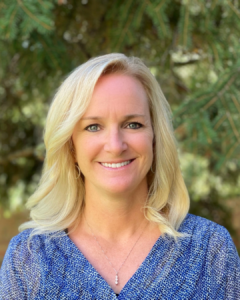
Tami Hall, Operations Manager, Musana
The events themselves were strong. Donors showed up, gave generously, and went home feeling connected to the mission. The harder part came afterward, in the stretch of hours Tami spent reconciling what the room had raised with what actually landed in the donor database.
Guest registration lived in Raiser’s Edge. Checkout ran through a separate payment tool. The two did not talk to each other, which meant a transaction could go through without the donor’s information attached to it. The result was a guessing game at the worst possible time, the end of an exhausting event day. “We were kind of trying to play a mystery game of who actually checked out at the end of the night,” she says.
The safest fix was also the most punishing one: sit down after every event and key in each transaction by hand, one at a time. Importing a spreadsheet looked faster on paper, but it spawned duplicate records and database errors, so doing it manually was actually the cleaner path. Cleaner did not mean quick. It stretched to 8 or 12 hours of data entry after a day that had already run long.
It was not a broken system. It was a capable person carrying the seam between two tools on her own back, every single event.
The one filter that decided everything
When Musana started looking for something better, the search began with a single non-negotiable requirement: it had to integrate with their Blackbaud product, and it had to do it for real. Tami had been burned by the promise before. “There are so many products that say they integrate and then they don’t, and it’s clunky,” she says.
That filter led the team to Trellis. What held their attention was something harder to put on a feature list. In the early conversations, it felt less like being handed a fixed system and told to fit inside it, and more like being met where they actually were.
“I just felt like Trellis really was eager to work with us and what would work for our specific organization, and it wasn’t this super hardcore system where it couldn’t be tweaked to meet our needs.” — TamiHall, Operations Manager, Musana
29 degrees on the course

No frozen line at a checkout table. Golfers gave their name, played, and finished checkout from their own phones out on the course.
Musana’s first Trellis event was a golf tournament in Denver. The team had already started registering people by the time they signed on, so Tami sent over a spreadsheet of guests with whatever contact information she had, and the Trellis team handled the upload on the back end. The check-in tables went up. Golfers walked over, gave their names, and moved on.
Then it started to feel like winter. The feels-like temperature that day hit 29 degrees, with snow and rain in the mix. Golfers were out on the course, not waiting in lines, and reaching them mattered. Built-in messaging let the team send updates and checkout reminders to everyone while they were out in the cold, including notes for donors who wanted to give through a donor advised fund. Those who had not checked out by day’s end could be sent a direct link to finish on their own phones. Nobody stood at a window in a frozen parking lot.
“It seriously made our check-in process so much easier, and checkout was the best, because golfers could just scoot out to the course and warm up and they weren’t worrying about standing in line,” she says.
Tami had recruited tech-savvy volunteers to run check-in, then found she had not needed to. The onboarding resources, the follow-up videos, the knowledge-base articles, even a walkthrough video she could share with her volunteers before they arrived, meant the people at the tables were ready without a crash course. “I don’t even think you’d really need to be tech-savvy, because it’s pretty straightforward,” she says.
When the auctioneer stood by the doors
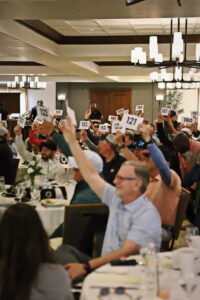
“It’s not a recycling bin. It’s not a trash bin. You’re actually going to be charged $100.” Donors who’d already given thousands dropped their paddles anyway.
Something unplanned happened with the paddle raise. The ask started at $25,000 and worked its way down to $250, sweeping the major and mid-range donors. Then the auctioneer had one more idea. He stood by the exit and invited anyone leaving to drop their paddle into a basket on the way out, for $100 a paddle.
He made the terms unmistakable. “It’s not a recycling bin. It’s not a trash bin. You’re actually going to be charged $100,” Tami recalls him telling the room. People who had already given $1,000, or $25,000, stopped and dropped their paddles anyway. That single move at the doors added another $2,200 to the night.
“It just felt more elevated, professional, just a better experience for everybody.” — Tami Hall, Operations Manager, Musana
The event raised more in 2025 than the year before, in snow and rain, on the back of a hardworking team, a compelling mission, and a creative auctioneer. The platform’s job was quieter: handle the operational weight in the background so the team could pour itself into everything that actually moves a room.
A database that finally behaves
The visible win was the event. The less visible win was what did not happen afterward.
The moment someone checked out, the transaction synced to Raiser’s Edge automatically and landed on the right gift record, exactly how it was supposed to look, with paddle raises, auction items, and appeals tracked as separate line items rather than a lump to untangle later. The matching criteria for guest donors were specific enough that duplicates were rare coming out of the tournament, a detail Tami clocked immediately, because cleaning up duplicates had always been part of the cost before.
“I was literally manually keying in every single transaction when someone checked out. And with Trellis, it just instantly synced to Raiser’s Edge, and it was on the person’s gift record exactly how it was supposed to be. So it honestly probably saved me 8 to 12 hours of work just for me.” — Tami Hall, Operations Manager, Musana
There is also a compounding effect that was not obvious on day one. Every golfer who attended now has a complete, clean record in the system. When the gala, Taste to Transform, comes around, those same donors will buy tickets on the front end with their cards already captured, and walk in without anyone re-entering their information. The check-in line gets shorter every year the team stays on the platform.
Every fee is a dollar that didn’t go to Uganda
One feature came up almost as an aside, but it carried real weight. When donors process transactions through Trellis, they can choose to cover the processing fees themselves, so those costs do not fall on the organization.
For a team where each transaction fee is money that could have funded a scholarship or a hospital visit, that is not a small thing. “Every dollar we can send to Uganda matters,” Tami says. It is the kind of structural detail that rarely surfaces in a demo, but it reflects something about how the tool was built: with organizations like Musana in mind, where the mission margin matters on every single dollar.
What changes when the tools finally work together
Taste to Transform is coming, food trucks, live music, the founders on stage, silent and live auctions, a paddle raise, and now a donor database that is clean, complete, and ready. The team will not be rebuilding checkout records the next morning. They will not be keying in transactions one by one. They will be focused on the work.
Four events, more than a million dollars raised, and 8 to 12 fewer hours of cleanup on the books after the very first event. That is what it looks like when the backend finally works.
If your events run on a patchwork of tools that don’t talk to each other, if your team loses days after each event reconstructing donor data, or if you have ever stood at a checkout table playing a mystery game with a payment processor, there is a better way. We’d love to show you what it could look like for your organization.