How a 35-year-old wine and microbrew gala checked in 700 guests, ran a paper-free paddle raise, and closed the gap where gifts used to quietly disappear.
Every advancement office has a drawer it would rather you not open. Inside is the paper trail of a fundraising event that went well in the room and went sideways in the records. Handwritten bid sheets, a manual receipt or two, a paddle number scrawled next to a dollar amount that somehow never made it into anyone’s donor profile. The night raised real money. Some of that money is now a mystery.
For two people who had just inherited the largest fundraiser at their school, the drawer was not a hypothetical. It was an actual folder, opened in late summer, holding an actual donation that had never reached the database.
Erin Riley and Krista Zizzo were both new to Cathedral Catholic High School in San Diego when they took over the Wine and Microbrew, the school’s signature spring event and the single biggest source of funding for its athletics program. The gala was about to turn 35. Neither of them had run it before, and one of them had never worked in advancement at all. What they found when they went looking through the previous year’s materials reframed the whole assignment.
The folder nobody wanted to open

Krista Zizzo, Advancement Coordinator, Cathedral Catholic High School
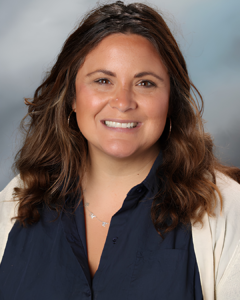
Erin Riley, Coordinator of Special Events, Cathedral Catholic High School
The discovery came during an ordinary question. Zizzo asked Riley something about the prior auction, and Riley went to the files to check.
“She opened a file folder and found the paper form that the previous event person had written down who was making those donations,” Zizzo recalls. “There was some grand amount of money that never got put into Raiser’s Edge. And so their year-end gift tallies were not going to reflect what they had done at the auction.”
“We were both kind of a little horrified at that. So wondering why our donors weren’t asking. They probably got a receipt, a manual receipt, but it never made its way into their actual donor record.”
That is the quiet cost of an event run on paper and goodwill. Donors give generously at the paddle raise, trust that the gift is recorded, and never think about it again. The organization, meanwhile, carries a donor database that is subtly wrong: year-end totals that understate what people actually gave, stewardship built on incomplete history, acknowledgment letters that miss the gift a donor remembers making. For a Catholic high school that depends on long relationships with its families, a giving record that does not match reality is not a clerical problem. It is a trust problem.
Inheriting a tool they didn’t choose
Riley and Zizzo did not select Trellis. The decision had been made before either of them arrived, part of a planned move off the school’s previous platform. They walked into their first Wine and Microbrew already committed to a tool neither had touched.
For Riley, who had come from outside the advancement world, that could have been daunting. Instead, the runway turned out to be the point. She spent serious time in the platform before the event, loading the silent auction, learning where everything lived, making sure she understood the tool well enough to explain it to someone else.
“I wanted to make sure that since it was my first year at the event and my first time using the tool that I really understood what the features were and how to be able to talk to somebody else about it.” — Erin Riley, Coordinator of Special Events, Cathedral Catholic High School
What made the platform worth committing to, though, was not the auction setup. It was the integration. The reason the school had chosen Trellis in the first place was its direct sync with Blackbaud Raiser’s Edge, the gap that the old platform had left wide open. A single phone call between the school’s business office and their Trellis representative connected Raiser’s Edge, payment processing, and the event platform into one flow. The thing that had let donations slip into a file folder was, structurally, closed.
Seven hundred guests, four lines, and zero bottlenecks
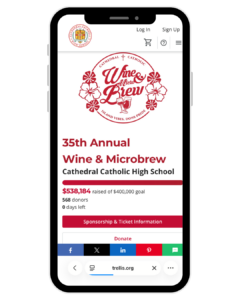
The Wine and Microbrew’s silent auction, built in Trellis and optimized for mobile so guests could browse and bid from their phones. The built-in stock photo library handled imagery for the lots, a perk Erin hadn’t thought to want until she was loading items the week before the gala.
The Wine and Microbrew draws 700 people. A check-in line that size can set the tone for an entire evening, for better or worse.
Cathedral Catholic handed it to teenagers. Student ambassadors, eight of them, staffed the entrance: four lines checking guests in by iPad, with a second student at each table ready to hand over the right paddle. The team had split the room alphabetically, A through M on one side, N through Z on the other, paddles divided to match. A guest walked up, a student typed the first letters of a name, the full record appeared, and the paddle was already in hand.
The students, who use a range of tools across the school’s departments, delivered the verdict themselves: it was the easiest check-in process they had ever done. For a group that grew up on screens, the interface needed no manual and almost no training.
A few decisions upstream made the night move faster. A separate VIP reception for roughly 100 to 150 guests pulled the heaviest arrival crush out of the main door. Swag bags were handed out at the end of the night, keeping check-in lean: confirm your information, grab your paddle, and walk in. Guests had already added their credit card and email before arriving.
One feature saved the team from a small nightmare they had genuinely braced for. With 700 attendees, assigning paddle numbers by hand was a real prospect until they found the batch upload.
“At one point I think you and I both looked at each other. We were like, wait, are we going to have to do this? We didn’t. Thank you, Trellis.” — Erin Riley, Coordinator of Special Events, Cathedral Catholic High School
The paddle raise that stayed a paddle raise
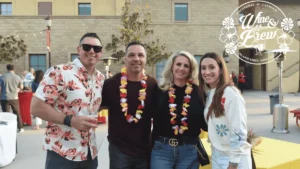
With check-in handled in seconds and swag bags saved for the end of the night, guests spent the evening doing what a 35th-anniversary gala is for. Behind the scenes, every paddle raised in this room flowed straight into the school’s donor records.
Here is where a lot of fundraising software gets it wrong: it tries to replace the moment. The paddle raise is theater. People come expecting to lift a number in the air, to be seen giving, to feel the room move together. Asking a donor to stop, pull out a phone, and type “number 123, put me down for 500” drains the energy out of exactly the moment you most want to charge.
Cathedral Catholic kept the theater. Guests raised their paddles. Volunteers moved through the room collecting them, dropping numbers into baskets, and afterward Riley used the platform’s quick entry tool to record who gave what. The excitement stayed live and human; the data entry happened cleanly behind it.
“It still allowed us to capture the excitement of donors making gifts live at the event, but then the ease of putting it into the system.” — Krista Zizzo, Advancement Coordinator, Cathedral Catholic High School
The contrast with that file folder could not be sharper. The same live, paper-driven energy that had once let a gift vanish now flowed straight into Raiser’s Edge, matched to the right donor, the night the gift was made.
The benefit they walked in not knowing they needed
Riley and Zizzo signed up expecting an event tool. What they got was a reporting tool that changed how they talk to the people they answer to.
After the event, the dashboard gave Riley a clear, visual picture of the night: revenue streams, top checkouts, tickets sold, quantities of each item. That picture went straight to the school’s president in a form that was easy to present and easy to defend. Underneath it sat an export she could open to dig into the numbers herself, tease out the detail, and answer the follow-up questions a leadership team always asks.
“Having that amazing dashboard for fundraising results was huge because it was a very easy, visually appealing way for me to present that information to our president.” — Erin Riley, Coordinator of Special Events, Cathedral Catholic High School
For two people in their first year, walking into the president’s office with a clean dashboard instead of a reconciled spreadsheet was not a small thing. It changed what their early credibility was built on.
The detail nobody puts in the brochure
The stock photos were good.
It sounds trivial. It was not, to the person loading 700 auction items the week before a gala. Riley had braced to source or stage imagery for every silent auction lot. Instead, the platform’s built-in photo library handled it, and handled it well enough that she called it a perk she had not even thought to want. Cathedral Catholic also discovered the system auto-generated the printed item descriptors that normally have to be made by hand, the little cards that sit in front of each basket. Work that used to be a separate craft project simply came out of the tool.
These are the details that do not sell software but do save a team’s last week before an event, the one where every saved hour is the difference between calm and chaos at the door.
What they would tell the next school
A year in, Cathedral Catholic is not weighing alternatives. The team is mapping where else the tool can go: a golf tournament in October, and other events across the year that have no auction at all but still need the part that turned out to matter most, fast check-in, ticketing, and texting. The advice Riley offers a peer is plain.
“I would tell them, especially if they use Raiser’s Edge, to make the move. It’s a really easy tool.” — Erin Riley, Coordinator of Special Events, Cathedral Catholic High School
Zizzo brings the perspective that only comes from using the platform under pressure. It feels built by people who have actually run auctions and galas, often anticipating requests before she has to make them.
For a 35-year-old event that had been quietly losing gifts to a file folder, the biggest change was simple: the money raised is now the money the records show. Less time spent wondering what slipped through means more time focused on the families and athletes the night exists to support.