How GRACE Christian School Finally Stopped Babysitting Their Gala and found a platform that finally keeps up with their team.
Every year, the gala ends. The guests go home, the venue empties, and the team exhales — for about five minutes. Then the real work begins.
For advancement teams at schools and nonprofits, the post-event recovery is almost a rite of passage. Someone has to gather the bid sheets, build the spreadsheet, reconcile the numbers, enter the data, run the credit cards, catch the failed payments, send the receipts, and do all of it again in the next database, and then the one after that. It is not glamorous work. It is not strategic work. But it has to be done, and it usually falls on the same one or two people who just spent weeks pulling the event together in the first place.
If that sounds familiar, you are not alone. The problem is rarely the team. It is rarely the mission or the community. More often than not, it is the tools, and the particular exhaustion that comes from trying to run a sophisticated fundraising operation through software that was not built to support one.
The Gala That Never Really Ended

Lauren Williams, Advancement and Database Administrator, GRACE Christian School
GRACE Christian School has been running galas and auctions for over a decade, and by most measures, the events had always been a success. Strong community turnout, a culture of generosity, a team that knew how to pull it together. But every year, as the final paddle came down and the auction closed, Lauren Williams, the school’s Advancement and Database Administrator, knew exactly what was waiting for her on the other side.
The data from each event had to be entered into three separate systems: the auction software, the donor database, and the financial database. Each required its own manual input, in full, from scratch. Credit cards were captured at the event but not charged; they had to be run manually afterwards. And if a card declined, the follow-up was entirely manual, too. No automation, no handoff, no shortcut.

To the donors in the room, a paddle raise is the emotional high of the evening. To the team behind it, every hand in the air used to mean another row of manual data entry and weeks of reconciliation ahead.
“Last year, it took us over three weeks just to get the credit cards to charge from the event,” Lauren said. “Just to get the data in and to charge the credit cards.”
The paddle raise was its own ordeal. Bid amounts and donor numbers came in on paper, traveled through an Excel spreadsheet, were compared against the original bid sheets, then got entered by hand into the first database and the second. Person by person. Row by row. In the year before they switched, the school had run roughly 90 auction items and a full paddle raise. Lauren got through it, as she always did. But she dreaded it, as she always did.
Meanwhile, the platform itself was not doing the organization any favors. At the point of sale, the system took credit card details without actually charging them. The first year they used it, the team did not realize that the cards were not processing in real time. The auction pages were visually clunky, difficult to customize, and lacked the kind of visual quality that makes donors feel confident in what they are participating in. For a team already running at capacity, every extra step is compounded.
The Integration Nobody Else Could Offer
The shift started when GRACE Christian School moved to Blackbaud’s Raiser’s Edge as their core donor database. With that transition came a clear new question: what fundraising platform would actually work alongside it? Raiser’s Edge has an event module, but it cannot run auctions. Lauren researched the field carefully, looking for something that could handle the full auction and gala experience and communicate directly with Raiser’s Edge, so that data entered once would not need to be re-entered elsewhere.
Trellis surfaced as the clear first choice. “No other company even came close when I was researching it,” she said. The Raiser’s Edge integration was the decisive factor, but the onboarding experience reinforced the decision. A dedicated support contact, Rachel, worked closely with the team through their questions and their feature wishlist, and when they came with ideas based on things they had valued in the old system, the response from Trellis was to listen.
The Night the Data Finally Behaved
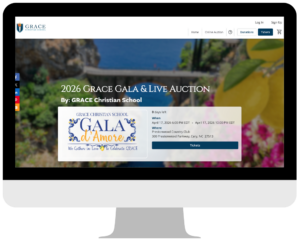
GRACE Christian School’s event page on Trellis. “When you went to click and buy your tickets, it was easy,” said Event Coordinator Megan Olsen. For a gala that draws current parents, alumni families, and longtime community supporters, the experience on the other side of the screen matters as much as anything happening in the room.
GRACE Christian School’s first gala on Trellis brought immediate, visible change. For the first time, the team checked guests in at the door, something they had never been able to do before. The auction pages looked polished, easy to browse, consistent with the school’s marketing. The whole front-end experience felt like something the team was proud to attach its name to.
But the moment that reframed everything came during the paddle raise. Where the previous year had meant paper paddles, bid sheets, spreadsheets, and weeks of post-event reconciliation, this year Lauren had every giving level preset in the system before the event began. As donors raised their paddles from the floor, she typed in bidder numbers in real time, level by level: $5,000, $1,000, and down through the tiers. The system summed the totals instantly. The data flowed into Raiser’s Edge, which in turn communicated with Financial Edge. The cards were charged. The receipts went out, each one already reflecting the correct tax-deductible amount, calculated automatically from the fair market value entered for each item.
“We were recording stuff live at the gala, which we’ve never done before,” Lauren said. “It just saved us so much time. We knew our final results so much faster.”
What had taken three weeks took one day. What had taken weeks for the paddle raise took a couple of hours. The school had twice as many auction items this year — 200 compared to 90 the year before — and twice as many Paddle Raise participants. The volume of activity nearly doubled, and the time to process it collapsed. Not one donor flagged a data error.
“We went from completely inefficient to super efficient.” — Lauren Williams, Advancement and Database Administrator, GRACE Christian School
The Clarity They Did Not Know They Were Missing

Michelle Bandy, Director of Community Advancement, Grace Christian School
The obvious win was time. But what the team gained beyond time was something harder to capture in a single line.
With daily ticket purchase tracking built into the platform, Michelle Bandy, Director of Community Advancement, and the rest of the advancement team could see exactly when donations and ticket sales spiked, correlate those moments with specific email campaigns or social media pushes, and adjust their outreach in real time throughout the campaign. That kind of day-by-day visibility had not existed before. As Margaret Minuth, the Assistant Director of Community Advancement, described it: “Lauren and I are data nerds. We love it. We’re data nerds, admittedly and proudly.”
With everything now living cleanly in Raiser’s Edge, Margaret is building a new layer of reporting infrastructure: custom reports, year-over-year comparisons, goal-setting grounded in actual donor behavior rather than just totals. Some of the data from their old platform never made it into Raiser’s Edge at all, simply because transferring it would have taken more time than anyone had. That gap, accumulated over years, had quietly limited how strategic the school’s fundraising could get. With the event data finally complete and accessible, that ceiling lifted.

Margaret Minuth, Assistant Director of Community Advancement, GRACE Christian School
There was another benefit the team mentioned that is easy to underestimate. With event check-in used for the first time, the school now has a clear picture of who actually attended, not just who purchased a ticket. For an advancement team building long-term donor relationships, that distinction is not a small one.
What Your Donors Notice Before They Ever Place a Bid
Margaret has a marketing background. She has built websites. She knows what a trustworthy online experience looks and feels like, and she knows what runs through a donor’s mind when the platform does not inspire that trust.
“When you go to something that looks like it was built on WebTV or some outdated platform,” she said, “you kind of wonder: is my credit card secure? Am I going to be interested in really participating in this auction? Is my data safe here?”
The platform the school had used before carried another problem that was harder to explain away: it allowed outside users to bid on items unless the team manually locked that setting before each event. The team had to remember to do it. Sometimes it required troubleshooting on the day. “That was really sketchy for us,” Margaret said.

Megan Olsen, Event Coordinator, GRACE Christian School
Trellis, by contrast, looked like something worth participating in. The auction listings were visually compelling, the donor experience was clean and modern, and the platform gave donors no reason to hesitate before entering their payment details. After two auction cycles with the old software, Margaret had become accustomed to a particular kind of frustration: “You can just wash up a pig and it still looks like a pig.” The whole Trellis platform looked great, she said, and made her feel proud that it was something the school could promote.
Megan Olsen, the school’s Event Coordinator and a first-year member of the gala team, put it from the attendee’s perspective: the platform matched the marketing the school had built around the event, and on the day itself, it simply got out of the way. The week after the gala, her team was still talking about it, not to process what had gone wrong, but because the experience had been genuinely good. “We were joyful about it,” she said. “It wasn’t a stressful time.”
The Numbers, and the Monday Morning They Didn’t Dread
Last year, GRACE Christian School raised $309,000 across their auction and gala. This year, on Trellis, they raised $466,000, a 50 percent increase, with twice the auction items, twice the Paddle Raise participants, and a post-event reconciliation that took one day instead of three weeks. Not one donor flagged a data error. The team finished the event joyful rather than depleted, and Lauren is planning her first real post-gala vacation.
The results came from a community that showed up and a team that knew how to meet them. But the tools made it possible to focus on what actually drives fundraising: relationships, momentum, and the ability to look at your data instead of fighting to get it into the right column of the right spreadsheet.
If your post-event recovery is taking longer than your pre-event planning, it may be worth taking a closer look at what is running under the hood. See how Trellis works with Raiser’s Edge, and what your next event could look like.