How Child and Family Agency of Southeastern Connecticut stopped reconciling paper bid sheets and started fundraising like the $22M-budget organization it is.
The bid sheet is on the third folding table from the door. Someone has crossed out a name. Two people are circling the same item. Tomorrow morning, somebody on staff will spend a week and a half reconciling who paid for what, chasing credit cards that didn’t go through, mailing tax letters one envelope at a time, and copying donor information from a clipboard into the CRM by hand.
If that scene feels familiar, you already know the cost. It is not just the night of the event. It is the week and a half after, the missed donor follow-ups, the gala that looks like it was thrown together because, in some ways, it was.
For Kate Careb, Chief Advancement Officer at Child and Family Agency of Southeastern Connecticut, that math stopped working a long time ago. Her team serves 10,000 families across the region with medical and mental health care, on a $22 million budget. Every hour a fundraiser spends entering an address into a database is an hour she is not bringing the next major donor to the table.
If the platform doesn’t earn its keep, the event doesn’t either

Kate Careb, Chief Advancement Officer, Child and Family Agency of Southeastern Connecticut
Kate spent years as a fundraising consultant before joining Child and Family full time. She walked away from contracts that did not include event software, full stop. The rule was simple, and she still says it almost word for word: “I will not take the contract unless I have event software.” It was a lesson learned the hard way during COVID, when paper auctions and manual reconciliations stopped being charming and started being a liability.
The pain was specific. Silent auctions where guests scribbled names on paper. Credit cards processed by hand and occasionally declined. Donor records that lived in two systems, neither of them complete. A development team buried in administrative work the week after every event, exactly when warm prospects expect a thank-you call.
She had used other platforms before, including GiveSmart. They moved tickets and ran auctions. What they did not do was talk to Raiser’s Edge.
“I will not take the contract unless I have event software.” — Kate Careb, Chief Advancement Officer, Child and Family Agency of Southeastern Connecticut
The shortlist that came down to one name
When Kate joined Child and Family Agency full time, Blackbaud’s Raiser’s Edge was already the system of record. Anything that did not feed into it cleanly was, by definition, more work, not less.
Her team evaluated several event platforms with one non-negotiable on the spec sheet: a real Raiser’s Edge integration. One vendor came back with one. “I think it was actually the only candidate that integrated with Raiser’s Edge,” she recalls. “It just became kind of a no-brainer.”
That was almost three years ago. She has not run an event without Trellis since.
What it looks like when the systems actually talk
Picture a guest at the agency’s annual fall gala. The paper invitation has a QR code on it. They scan, register, and pick their seats from the couch. The night of the event, they are bidding on auction items in full color, watching the leaderboard climb on their phone. A donor in a different time zone, traveling for work, is bidding too.
When the auction closes, Kate clicks one button. Notifications fire. Credit cards process. Tax letters generate and go out. The funds land in the agency’s account. The donor record updates in Raiser’s Edge automatically: the $1,000 ticket, the $200 auction item, the address, the phone number. None of it has to be retyped.
Working backwards from that moment is where the integration earns its name. When her team registers a golfer or a sponsor, they type a name and the rest fills in from Raiser’s Edge: address, phone, history, the works. The night-of transactions write back into Raiser’s Edge and Financial Edge automatically; nothing waits in a spreadsheet for someone to key in on Monday. As Kate puts it, “It’s fully immersive. We just enter it into Trellis and it knows Raiser’s Edge. It knows who that donor is. It pulls up all of their information.”
The result is the kind of operational quiet that nonprofits do not normally get on the morning after a gala. “Everything’s accounted for,” she says. “We’re not having to go and search for anything that donor might have donated. They might have done a $200 auction item. They might have paid a $1,000 ticket price. It’s going to show all of those things right in Raiser’s Edge.”
“We’ve more than quadrupled our revenues from events. And I do give a lot of the credit to Trellis for that.” — Kate Careb, Chief Advancement Officer, Child and Family Agency of Southeastern Connecticut
The platform also opens up revenue lines that paper auctions simply cannot. Silent auctions are no longer gated to whoever made it into the room; the agency now opens bidding to supporters all over the world, including donors who are traveling or who could not attend. Bidders who lose an item can convert what they would have spent into a direct donation, instead. Sponsors land on a page where their logo appears in full color next to a “Sold” tag, beside the headline sponsor slot, in a way that quietly nudges next year’s renewal. On event day itself, text messages keep guests in the loop on auctions, raffles, and program changes without anyone hovering over a microphone.
None of those features sound revolutionary written down. Stack them, and they explain how a fall gala that raised somewhere around $125,000 in year one cleared $350,000 last year, with multiple auction items valued at more than $15,000 apiece moving through the platform.
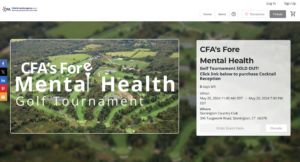
“It’s a good hygiene thing. It just works well.” Translation: when Child and Family Agency’s logo shows up on a page that handles a $350K gala without seams, donors stop subconsciously deducting points before the ask is even made.
What changes when nobody has to retype an address
The numbers are the part that gets the meeting.
Event revenue, more than quadrupled. The fall gala alone, nearly tripled. But the change Kate keeps coming back to is not the topline. It is what her team does with the time the platform gives back.
Building an event, in her words, is now a matter of cutting and pasting last year’s into this year’s, then refreshing the auction. “We don’t have to put a lot of time into building anything,” she says. “We can now spend our time really working on getting new donors to the table.”
That shift, from execution work to relationship work, also changed how donors see the agency itself. “A lot of donors look at us as a mature organization that they’re comfortable aligning with,” she says. The graphics look right. The communications go out on time. The auction closes cleanly. None of those things are flashy on their own. Together, they signal an organization worth a major gift.
There is a second-order effect she did not expect. The Chief Advancement Officer now recommends Trellis to other organizations as casually as she recommends a good caterer. Last week alone, she sent a referral. Her pitch was confident enough to draw a real number out of the air: “I told them I believe their revenue will double next year just utilizing this system.” She has done the same with the Connecticut Association of School-Based Health Centers, this time skipping the pitch deck entirely. Her opener was the link to her own live golf-tournament page. “Check it out, have fun with it. See how colorful it is. Register yourself as a free silent auction viewer and participant. You’ll see exactly what the experience will be like if you use it.”
When a Chief Advancement Officer hands prospects her own event as the demo, the platform has cleared a bar most software never reaches.
The part she will not say in a board meeting
Here is the thing fundraisers think but rarely write down. A silent auction with paper bid sheets and a folding table looks exactly like a silent auction with paper bid sheets and a folding table. It does not matter how good the cause is. The aesthetic is the message, and the message is, “we’re figuring this out as we go.”
Kate puts it more colorfully than most development directors would.
“We don’t look like we’re rinky-dink. We are real professionals, and the platform helps give us that professional look.” — Kate Careb, Chief Advancement Officer, Child and Family Agency of Southeastern Connecticut
That sounds vain until you remember who is watching. Sponsors scrolling the event page see their own logo with a “Sold” tag in bright color. Donors see auction items in real photographs, on a page that does not look like it was built in 2009. None of that raises a single dollar by itself. All of it raises the ceiling for what the room is willing to give.
What the next event looks like

Kate now hands this same page to other nonprofits weighing whether to invest in a platform. “Register yourself as a free silent auction viewer. You’ll see exactly what the experience will be like if you use it.” The goal for May 11: $100,000 raised in a single afternoon.
On May 11, the agency runs its annual golf tournament. Her team registered every golfer through Trellis, set up the silent auction through Trellis, and will text participants throughout the day with logistics and bid alerts through Trellis. The goal is $100,000 raised in a single afternoon, for a region that needs every dollar of it.
When peers at other child and family agencies ask her whether the investment is worth it, the answer is short. “Honestly, I wouldn’t even consider running an event without you guys. I really wouldn’t.”
Three years in, the case for Trellis is not the platform. It is the gala that grew from $125K to $350K. Event revenue, more than quadrupled. The auctions open to bidders three time zones away. The Tuesday morning that no longer starts with a stack of paper bid sheets and a backlog of thank-you notes.
If your team is rebuilding the same event from scratch every year, or watching donor data slip between platforms, the conversation is a short one.