A sponsor-first gala that finally had room to feel like one.
Running a mayor’s gala isn’t like running a festival. There’s no crowd to absorb the friction, and sponsors see every seam.
When the event is only three hours long and built around the people paying to be there, the check-in desk, the silent auction, and the moment a guest pulls out their phone to bid all become tests the night has to pass, and small delays compound quickly, and clunky forms start to feel less like software and more like the event itself pushing the donor away instead of pulling them in.
For sponsor-driven galas, the real product isn’t the raffle or the bar or the stage. It’s the feeling of being taken care of from the moment a name gets checked off at the door.
The hidden cost of a platform that almost fits
For several years, the City of Surrey’s Special Events team produced the Mayor’s Annual Gala, a fundraiser for the Surrey Firefighters Charitable Society and their nutritional snack programs for youth, on a platform called Givergy. It was, in the words of the City’s Senior Special Events Marketing Specialist, Amy Kim, “fine.”
Fine means nothing is actively broken, but fine also means nothing is actually great.

Amy Kim, Special Events Marketing Specialist, City of Surrey
The friction points were small but very specific. Ticketing couldn’t be customized the way the team wanted for sponsors, even though the gala is sponsor-driven at its core and the ticketing flow that treats them like a general-admission buyer sets the wrong tone before the event has even started.
“They’re contributing a lot of value to the event, so we want to curate that experience as seamlessly as possible for those sponsors.” — Amy Kim, Special Events Marketing Specialist, City of Surrey
When the platform couldn’t bend that far, her team built workarounds — the kind that make the person running the event feel like they’re apologizing for the tool instead of championing it.
Support was slow, too. Questions that needed answering in the hours before doors opened often sat in an inbox while the team anxiously tried to find even more workarounds to make the platform function..
And then there was the hardware. In past years, when using other platforms, the team had paid to rent vendor-supplied tablets for check-in and auction bidding. Cases shipped in. Cases shipped back out. The budget was spent on equipment that served the event for three hours and then disappeared into a courier van.
“I don’t really feel the need for all this luggage. People know nowadays that you can just input your information into a phone or a website and make transactions that way. We’re moving that way as a society.” — Amy Kim, Special Events Marketing Specialist, City of Surrey
A recommendation from across the fire hall
The nudge didn’t come from a sales pitch. It came from another firefighters’ charitable society, Delta’s, a partner organization that had already moved to Trellis and couldn’t stop saying good things about it.
What sealed it for Amy was smaller than a feature list. The team could see who owned and ran the platform, a kind of transparency that’s rare in the category, and one that mattered for a team producing the city’s signature event on behalf of the mayor’s office.
“We were looking for a company where you could see who owned it and who ran it.” — Amy Kim, Special Events Marketing Specialist, City of Surrey
Inside the three-hour reception
That year, after switching to Trellis, the gala was scheduled to run as a tighter cocktail reception. Three hours, start to finish. That compression made every process decision heavier. Nothing had room to lag..
Check-in was the first relief. Instead of walking each guest through a form on arrival, the team could search for a name, tap to check them in, and move them into the room. If someone hadn’t finished their profile, there was an option to capture the details on the spot. If they were just there to attend, a sponsor’s plus-one with no intention of donating, staff could bypass the form entirely and keep the line moving.
That distinction was the difference between a line that breathes and a line that backs up into the foyer.
The silent auction was the second relief. It lived on a browser, and the team could pull up the bidding site on the hardware they already owned.The team set up a couple of iPads around the room, a laptop at the back, and staff phones as backup. Guests who wanted to bid on their own device scanned QR codes posted throughout the venue. There was no rental shipment, no vendor cases in the back hallway and no extra budget line for tablets that had to be packed up and couriered back at midnight.
But best of all, when Amy or any member of the team did hit a question, her point of contact at Trellis, Rebecca, was usually one message away.
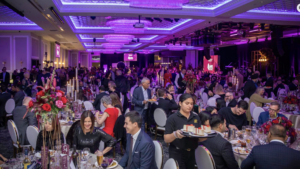
The Mayor’s Annual Gala in motion — three hours, a sponsor-first check-in, and a silent auction that lived in a browser tab.
What the team didn’t know it was missing
The thing the Special Events team didn’t expect to gain was confidence. Confidence that a question on event day wouldn’t disappear into a queue, that the check-in line wouldn’t stall on a sponsor who just wanted to walk in and that the team’s own equipment was enough and that no one needed to sign a hardware rental again.
The detail you notice at 2 a.m. the day before the event
Event prep has a predictable rhythm. Somewhere between the run sheet getting finalized and the doors opening, a small question always comes up, about a ticket type, a sponsor tier, a bidding rule and often the person asking doesn’t have time to wait for a reply.
For a lot of other platforms, the help article either doesn’t exist, or it exists but reads like a marketing paraphrase of a feature instead of an answer to the question actually being asked.
When Amy brought something like this to Rebecca, her main contact at Trellis, the first response was usually the same: a link to the help article that already covered it. And the articles actually did.
“The way I read it, it’s like someone actually faced this issue and then wrote it in a way where someone facing the same issue could solve it step by step. I really appreciated the screenshots, too. That made it really easy to know where I was in the process.” — Amy Kim, Special Events Marketing Specialist, City of Surrey
Small things like these are the difference between opening a support ticket and solving the problem in the two minutes before the next one lands. For a team running a signature event on a tight clock, that gap is measured in hours they get back that go back into the night itself and not into managing the software running it.
What Amy tells the next organizer who asks
Asked what had gone wrong with Trellis, Amy’s answer was, in her own words, that “nothing bad stood out”, the solutions she was looking for were always there, and the support she needed was always one message away. That’s a rare sentence in the events business, where most post-mortems are a list of things to work around next time.
The Mayor’s Gala raised money for the Surrey Firefighters Charitable Society. The team didn’t ship hardware, didn’t sit waiting on a support ticket, and didn’t spend the event apologizing to sponsors for the platform. Check-in was a search bar. The auction was a browser tab. The help articles….actually helped.
When Amy was asked what she’d tell another organizer considering the switch, her answer was specific.
“Trellis is one of the most user-friendly and intuitive platforms I’ve used. If you’re starting a new event, or transitioning from manual ticketing to a real platform, it’s a good place to start.” — Amy Kim, Special Events Marketing Specialist, City of Surrey
If you’re producing a sponsor-driven gala and the check-in desk feels like a bottleneck you keep apologizing for, let’s have a conversation.