A direct line into Raiser’s Edge NXT and a live check-in dashboard for four hundred guests turned an event that used to take a full day of manual entry into one she barely has to think about.
Alden Weeks used to know exactly how long it took to move a single gift from a donor’s inbox into the bank: about thirty minutes. A sponsor would email to say they wanted to support the next St. Bernard’s Healthcare event, and from there she walked that gift through every system her foundation owned by hand, checking it twice, before it ever showed up as money on the books.
Multiply that by the twenty to fifty sponsorships a typical event brought in, on top of the four hundred guests who showed up the night of, and it added up to roughly half of her workday. Every single day. Not because she worked slowly. Because the system she had built, a genuinely good system, still ran on spreadsheets, memory, and a lot of double-checking.
Weeks had inherited that system a few years earlier when she stepped into the development manager role at St. Bernard’s Foundation, the fundraising arm of a 126-year-old Catholic hospital system that serves close to half a million people across northeast Arkansas and southeast Missouri. She has a word for what she inherited: a beast.
A Beast Built From Spreadsheets
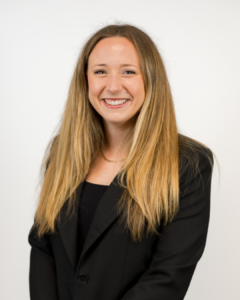
Alden Weeks, Development Manager at St. Bernard’s Healthcare
Rather than tear the whole thing down right away, Weeks spent her first couple of years just learning how the foundation actually operated before she changed anything. She tried different software, tested a few programs, and built a large number of spreadsheets to keep the foundation’s fundraising organized. It held together. It also meant that every gift, every sponsorship, every ticket sale lived first in her spreadsheets, and only later, after she or her office manager keyed it in by hand, inside Raiser’s Edge NXT and the rest of the foundation’s Blackbaud systems.
“I kind of inherited a beast, you know, and wanted to spend some time just looking at systems and things that had worked in the past.” — Alden Weeks, Development Manager, St. Bernard’s Healthcare
The gap between those two systems, her spreadsheets and the foundation’s actual database, was where most of her week quietly disappeared.
The Perfect Storm Her Boss Wouldn’t Let Her Ignore
The fix came from an unlikely place: a conference her boss attended without her. He came back convinced the foundation needed to talk to a company called Trellis.
What made it feel like a perfect storm was simple. Trellis could send event and gift data straight into Raiser’s Edge NXT, no spreadsheet required in between. But Weeks was not ready to hand over that much trust on day one. When her team ran its first event through Trellis, she left autosync off. She and her team watched the transactions come in, tested a handful of them by hand, and only switched the sync on once she had seen, with her own eyes, that it worked.
Four Hundred Guests, Fifteen Minutes, One Live Number
By the time St. Bernard’s Healthcare’s largest fundraiser of the year rolled around, the foundation’s Trellis journey was fully underway. Four hundred guests came through the door in a fifteen-minute window, volunteers working iPads at every station. What surprised Weeks was not the speed of check-in itself, but what she could suddenly see: a live, real-time count of how many tickets had sold against how many guests had actually walked in.
That single number changed how the night ran. Her team could glance at the dashboard, see they were halfway to their number or seventy five percent of the way there, and open the buffet line right then, making game-time decisions instead of guessing.
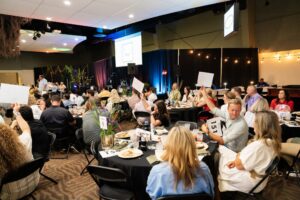
Guests raise their bid paddles during St. Bernard’s Healthcare’s Fund the Mission appeal, which brought in $65,000 in ten minutes.
The paddle raise, which the foundation calls Fund the Mission, told the same story. During the mission moment, a short video highlighting the service area the money would support, volunteers stationed around the room wrote down bid numbers at each giving level. Weeks and her boss sat down with two laptops and their bid spotting sheets and started entering numbers as fast as they came in.
“Our hands touched it, our eyes saw it, and so we know that it’s good, you know.” — Alden Weeks, Development Manager, St. Bernard’s Healthcare
Ten minutes later, they had a final number to read from the stage: $65,000, raised in that room, that same night. In the run-up to the event, when Weeks asked the Trellis team whether there was anything she should be doing proactively, like getting bid numbers bulk uploaded ahead of time, the answer came back fast. Someone on the Trellis side told her, “Yes, I can help you do that in the next two hours.”
What She Does With the Time She Got Back
The thirty minutes per sponsorship dropped to a single click. The half day spent tracking one gift from first email to bank deposit disappeared. What Weeks and her team chose to do with that time back says more about the shift than any hour count could.
“Our team inherited an organization that had been around for a long time and done things the same way for a long time. There was nothing wrong with that at all, but now we have the freedom to just kind of slowly make the wheel turn a little bit better, make it a little more jazzy and look a little bit nicer, and things like that.” — Alden Weeks, Development Manager, St. Bernard’s Healthcare
Some of that time now goes toward more intentional donor gratitude. On the back end in Blackbaud, the foundation set up its own triggers: a gift over $1,000 means someone picks up the phone, a first-time donor gets a different note entirely. Because Trellis purchases show up fast, the team can act on those triggers while the gift is still fresh instead of days later. The rest of the time goes toward helping other departments across the health system, work that used to be out of reach when half of every day belonged to spreadsheets.
The Moment She Stopped Missing Her Spreadsheets
Handing a donor database over to an automatic sync is not a small ask for anyone who built their own system from scratch by hand. Weeks admits the Blackbaud sync made her and her office manager nervous going in. Before it went live, someone from the Trellis team got on a call with them and pulled up both platforms side by side, showing exactly where each piece of Trellis data would land inside Blackbaud.
That walkthrough was enough. Weeks tested the sync manually through one full event first, watching each transaction land where it should. Then she flipped it on for good.
“Where’s this been all my life?” — Alden Weeks, Development Manager, St. Bernard’s Healthcare
She describes the platform itself the same way: intuitive enough that a task that used to take seven clicks in her old systems now takes one.
Worth the Jump
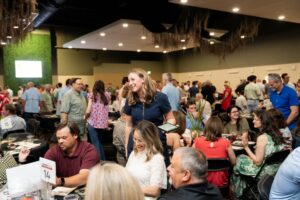
Attendees mingle before dinner at St. Bernard’s Healthcare’s fundraising gala, where check-in for four hundred guests now takes fifteen minutes instead of a full day.
St. Bernard’s Healthcare is now running its third event through Trellis, and some of its outlying hospitals have started using the same system to talk directly to Blackbaud. Weeks is in the middle of an active fundraising event as this story goes to print, autosync on, and she has not opened the settings since she turned it on. She checks the dashboard when she wants to see how much has come in. That is the extent of her involvement.
Sponsorships that used to eat thirty minutes apiece now take one click. A gift that used to consume half a workday now barely registers. A paddle raise total that used to wait until the next morning now gets read from the stage before the room empties out.
“I would say that I understand that change is a little scary, especially if you’ve been working in systems that have worked for you for a long time. But take the jump. It is just such a nice peace of mind to know that something works, it’s easy, there’s support if you need it, but it’s worth the jump for sure.” — Alden Weeks, Development Manager, St. Bernard’s Healthcare
For a foundation still running its biggest night of the year out of spreadsheets and a prayer, that jump might be worth taking too.