Home ›
Best Of › Gala Software for Raiser's Edge NXT
Best-Of GuideData current as of September 2026
9 Best Software for Running a Fundraising Gala on Raiser's Edge NXT (2026)
Most development teams shopping for the best software for running a fundraising gala have already run at least one gala on a platform that handled the night fine. The problem showed up the following Monday.
Ticket buyers, sponsors, auction winners and paddle raise pledges were sitting in the event tool, and somebody had to get them into Raiser's Edge NXT by hand. Ask a room of fundraisers how long that takes and hands go up at one week, two weeks, and some at six or seven. On the platform that actually integrates, it is the same night or the next day.
So the question this guide is built around is not which platform has the longest feature list. It is which platform lets your team close the gala and the reconciliation on the same night, while still giving every guest a way to bid without a password.
We assessed each platform first on how it writes into Raiser's Edge NXT (a real constituent-level sync, an import plug-in or paid middleware, or an export file someone imports) and how long reconciliation takes afterward, then on donor friction at the moment of giving, revenue tooling for tickets, tables, sponsorships, silent auction and paddle raise, event-night reliability, receipting, and total cost including processing fees and onsite staffing.
The verdict in a nutshell
We evaluated nine gala platforms used by US nonprofits raising $200K or more a year through events.
Trellis, our own product, is the best overall pick for teams running Raiser's Edge NXT, because it is the only gala platform that integrates directly with Raiser's Edge NXT in real time and one system for tickets, sponsorships, check-in, silent auction and paddle raise.
OneCause is the best full-service pick for organizations that want vendor staff in the room on event night, and it is the platform we lose to most often when a team wants exactly that. GiveSmart is the best all-in-one platform with a donor CRM built in. Givebutter and Zeffy cost the nonprofit nothing and are funded by donor tips that default to roughly 15% to 17% at checkout, which suits small events that do not need CRM-level data.
Trellis
Best Overall for Raiser's Edge NXT
OneCause
Best Full-Service
GiveSmart
Best All-in-One With Donor CRM
Givebutter & Zeffy
Best Free Options
Quick Comparison Table
Data is current as of September 2026 and pricing was verified against each vendor's published pricing page or review-site listing. Where a vendor publishes no price, the table says so rather than estimating. Processing fees and donor tips are listed next to platform fees because on a $200,000 gala they are usually the larger number.
About the Author
Justin Goodhew, Co-founder and CEO
Justin brings extensive expertise in nonprofit fundraising, donor engagement, and event technology. Through Trellis, he has helped organizations raise over $125 million across 500+ fundraising galas. His insights are shaped by firsthand experience working with nonprofits to simplify fundraising, improve event performance, and maximize mission-driven impact.
How We Evaluated These Gala Platforms
We scored every platform from 1 to 10 on six criteria, then weighted them. The weights are published so you can add up the numbers yourself.
Our Scoring Methodology
Raiser's Edge & CRM Integration Depth
25%
Native constituent and gift level sync versus import plug-in or paid middleware versus file export, and the reconciliation burden inherited after the event.
Donor Experience & Giving Friction
20%
Login requirements, app downloads, text-based giving, and drop-off at the moment of giving.
Revenue Drivers & Auction Tooling
20%
Tickets, tables, sponsorships, silent auction, paddle raise, raffles and bid-to-donation conversion.
Event-Day Reliability & Support
15%
Uptime, whether the platform runs without vendor staff in the room, how much training volunteers need, and what happens on the night if something breaks.
Reporting & Reconciliation
10%
Receipting, split receipting, fee handling, and how long the database team spends after the event: same night, days, or weeks.
Pricing Transparency & Fees
10%
Published pricing, platform fee plus processing fee, donor tip defaults, add-ons and onsite staffing charges, and the total cost of a $200,000 gala.
We weight integration depth highest because it is the pain that starts most platform searches in this category, even though buyers rarely evaluate on it first. Every event platform runs the night. The difference shows up in how many weeks your database administrator spends afterward. On the integration and reconciliation columns, a native sync scores 10, an import plug-in or paid middleware scores 2 to 3, and a file export scores 1, because moving from weeks of reconciliation to one day is a tenfold difference, not a two-point one.
Top 9 Software for Running a Fundraising Gala in 2026 Reviewed
What are the best software options for running a fundraising gala on Raiser's Edge NXT? The one that runs the night well and then puts every ticket, sponsorship and winning bid into the CRM attributed correctly, without a spreadsheet in between. Here is how the top gala platforms of 2026 compare on that test, ranked by the score above.
Our top pick
#1
Trellis
Best Overall for Raiser's Edge NXTFundraising Tech Score: 9.6/10
Best for: development teams at US nonprofits raising $200K or more a year through events, already running Raiser's Edge NXT, who want to reconcile the gala in hours rather than weeks.
Platform Overview
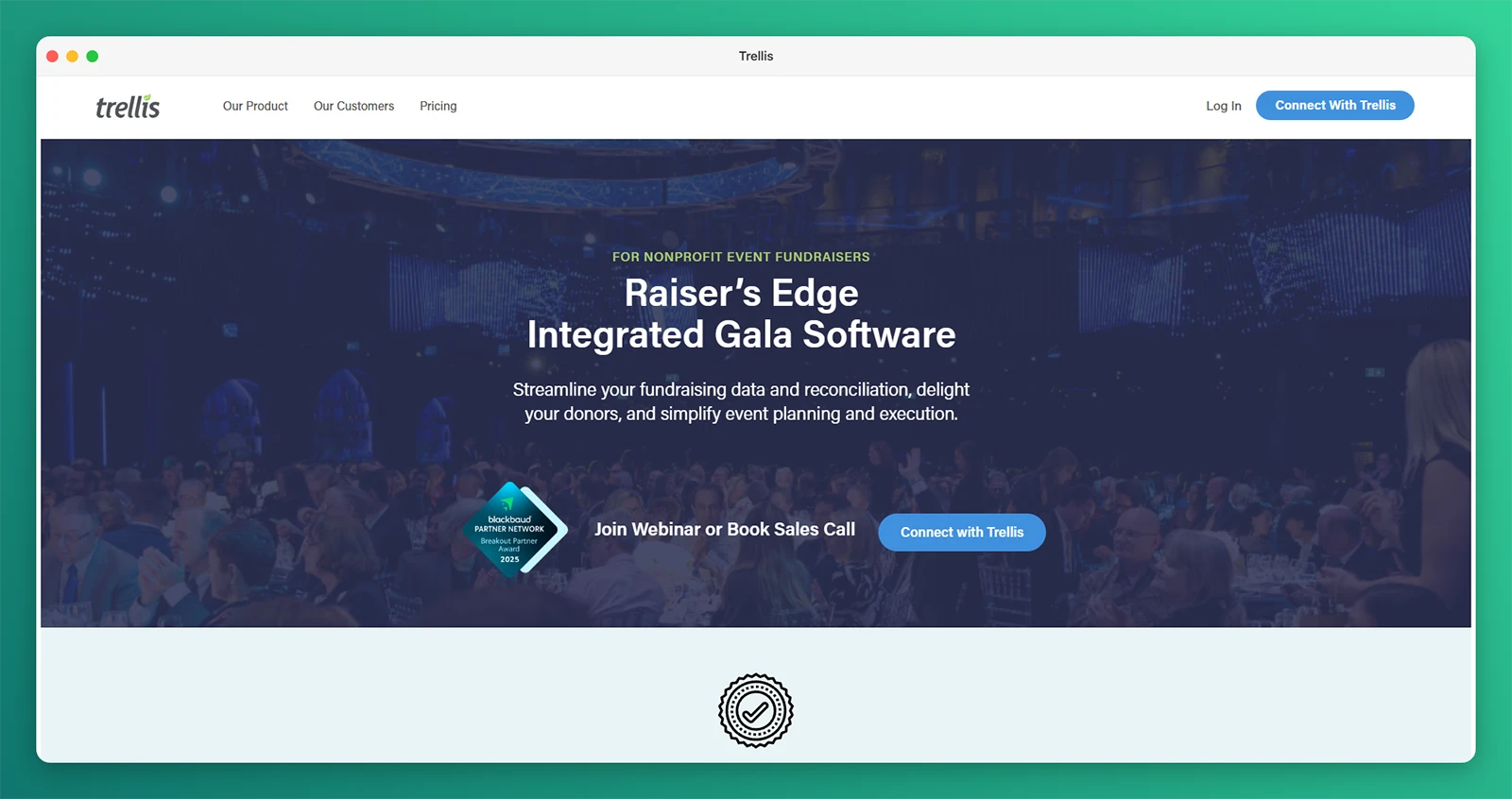
Trellis is our event fundraising platform for nonprofit galas, auctions and golf tournaments. If you use Raiser's Edge NXT and you raise over $200K a year through events, it is built for you.
We are the only platform that actually integrates with Raiser's Edge NXT, in real time and at the constituent, gift, campaign, fund, package, appeal and event level. The benefit is simple: reconciliation that takes other platforms two to five weeks takes Trellis the same night or the next day. Giving is text-first, so if your donors can receive a text message and click a link, they can give.
Tickets, tables, sponsorships, check-in, silent auction, paddle raise, raffles and add-on items all run in one system, and more than 500 galas have raised over $150 million on it.
The 4 Gala Problems We Built Trellis to Solve
The problem
The gala ran well, and then it handed back a spreadsheet.
Most event platforms advertise CRM integration. In practice it is an export someone imports, batches and de-duplicates after the event, often through a third-party plug-in. Ticket revenue arrives as a lump, auction winners arrive without gift attribution, and spouses become duplicate constituents. Post-event reconciliation takes weeks, sometimes months, at exactly the moment warm donors expect a thank-you call.
We are the only platform that integrates directly with Raiser's Edge NXT in real time, and that is not a feature, it is the reason customers choose us. Other platforms list Raiser's Edge as an integration. Read the documentation and it is an import plug-in run after the event or a paid middleware subscription. We actually integrate.
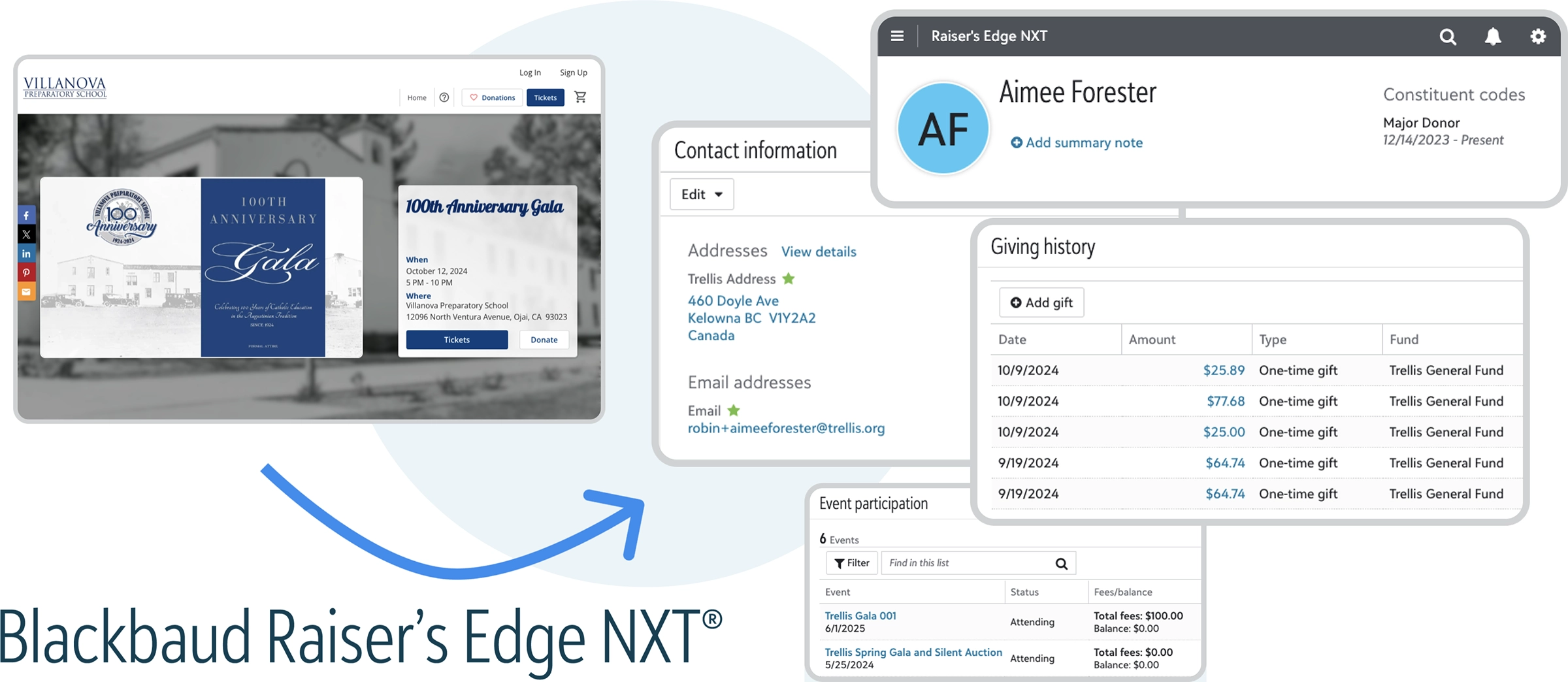
Every guest is matched to a constituent with your spouse and household rules, every ticket, sponsorship, winning bid and pledge is written as its own gift with campaign, fund, package and appeal mapping applied the moment it lands, and attendance is written to the Raiser's Edge NXT event module.
Post-event reconciliation that used to take weeks or months is finished the same night or the next day. Grace Christian School completed what used to be three weeks of post-event work in a single day, and one development team told us their database manager took a week's vacation after the gala with the reporting already automated.
The problem
Guests could not log in, so bids and gifts were lost.
Every event planner asks the same question first: will my guests be able to use it? A guest asked to download an app, create an account or reset a password in a dim ballroom stops. When the login screen wins, the bid never happens and the paddle raise pledge never gets recorded.
Trellis is text-first and mobile-first. If your donors can receive a text message and click a link, they can give on Trellis: a text arrives, they tap the link, and their account opens with no app download, no login and no learning curve. Before the event, guests add their card and check themselves in; during the event, everything runs through text messages and QR codes with no-login text links.
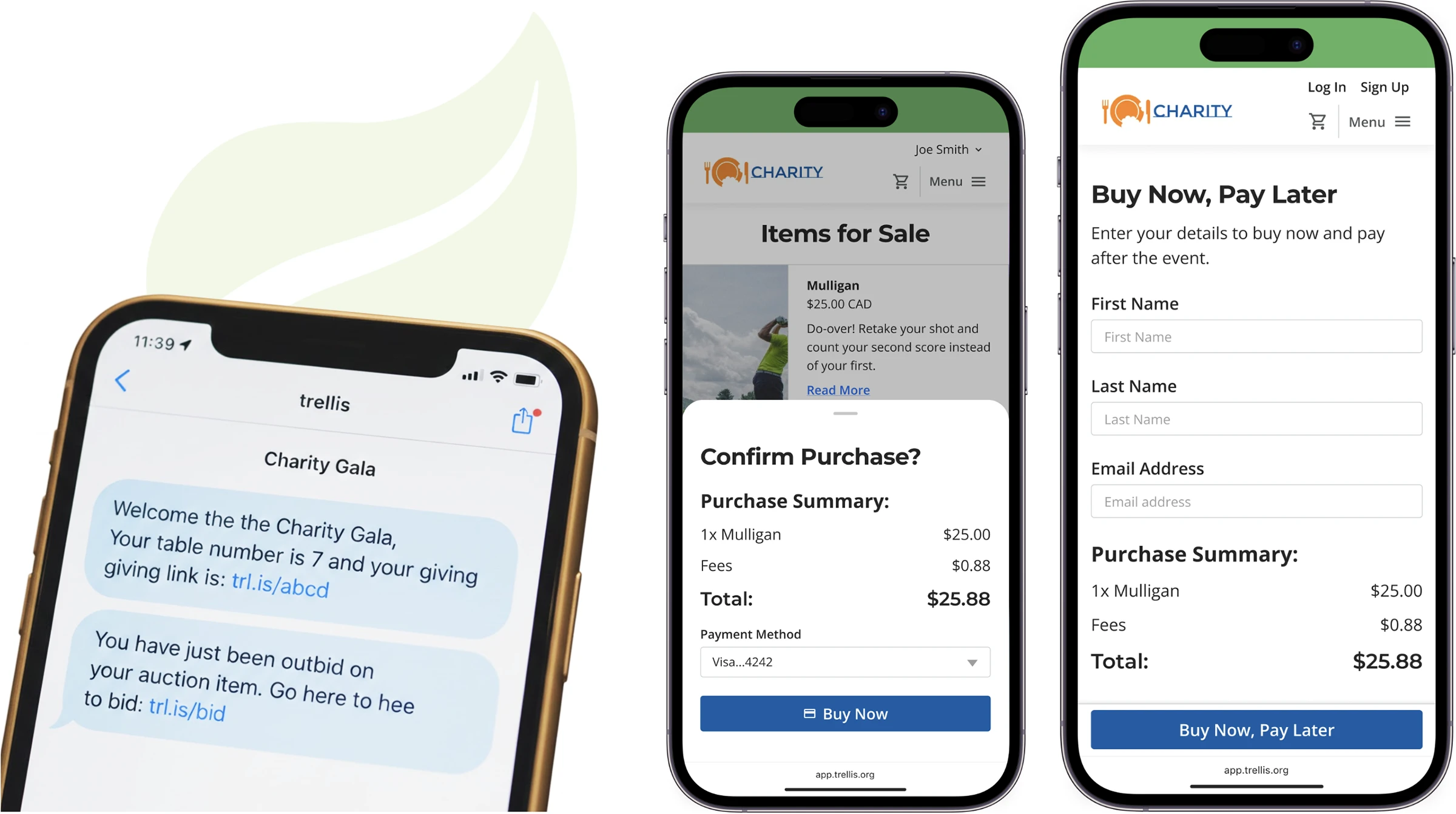
Outbid alerts, check-in confirmations with table numbers, a day-before reminder framed like an airline check-in and paddle raise prompts all arrive by text, tied to what is happening in the room. Easy enough that nothing goes wrong on the night of. That is the standard we hold ourselves to.
The problem
The event planner is the human bridge between systems, and the whole team pays for it.
Most platforms create work before, during and after the event. In the lead-up, colleagues chase the event planner for sponsor lists and guest details that already exist in Raiser's Edge NXT, then re-enter them somewhere else.
On the night, staff who were trained once are fielding questions all evening while the person on the hook for half a million dollars runs a check-in line. Afterward, everyone is pulled off their real jobs for a month of cleanup. The event most teams should love becomes the one they dread.
Trellis does the opposite. Before the event, your team pulls what it needs directly from Raiser's Edge NXT and Trellis, with no chasing the event planner, no manual exports and no re-entering data that already exists.
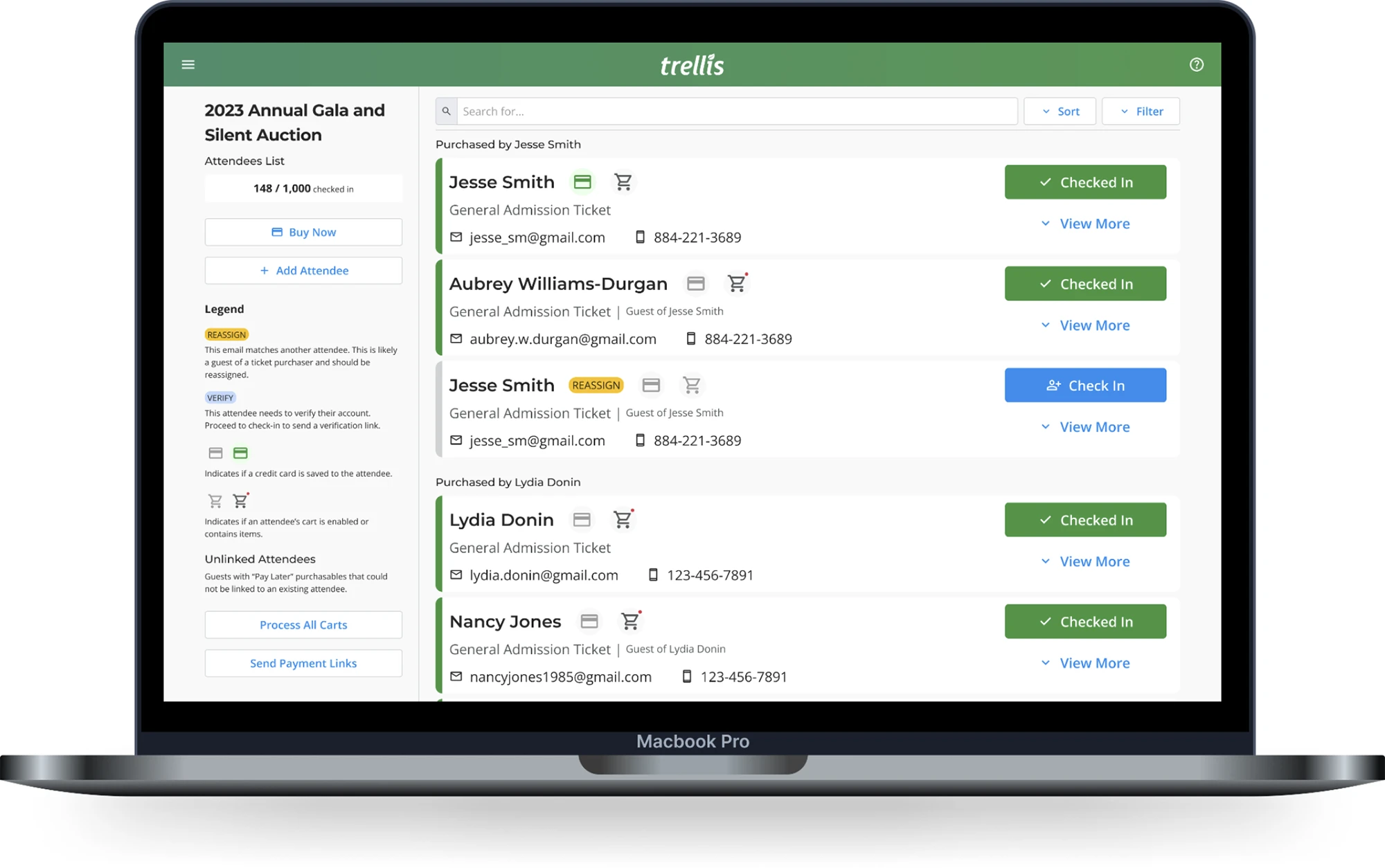
On the night, staff walk in and it just works, with no prior training required: hundreds of guests are checked in within minutes, and everything volunteers need is in front of them proactively, so the event planner gets to be present rather than stressed and fielding questions. Trellis runs at 99.99% uptime, and we publish it live for anyone to check at status.trellis.org. We build the product so it does not need a person from our company standing in your ballroom.
After the event, the data is already where it needs to be. Nuvance Health Foundation checked in 600 guests this way. The line we hear most often after a first Trellis event is a customer's: "my team doesn't dislike me anymore."
The problem
One evening, five tools, and money left on the table.
Ticketing in one platform, the auction in another, a card terminal at the door and a spreadsheet holding it together. Losing bidders go home having given nothing, and the paddle raise total is announced the next day after the pledge cards are counted.
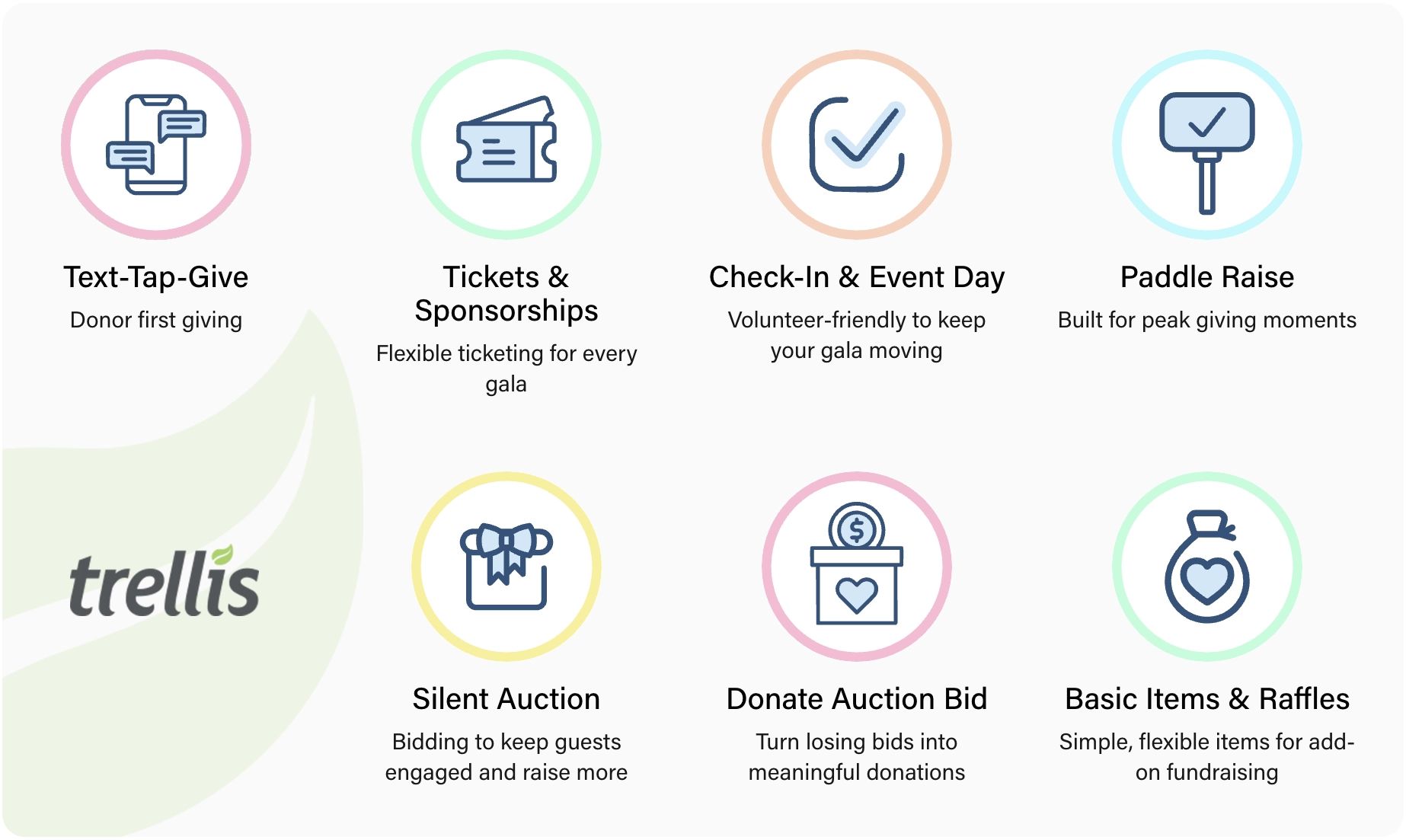
One system for every revenue type, and Donate Auction Bid on top. Tickets, tables, seating, sponsorships, one-tap check-in, paddle raise with live displays, raffles and add-on items all run in Trellis. The silent auction is fully automated mobile bidding: it can open early so people who are not in the room can bid, it auto-closes, it sends winning receipts and digital gift cards itself, and guests get a text when they are outbid and when they win. No paper, nothing to close by hand.
Donate Auction Bid captures a losing bidder's opt-in while they are still bidding and processes the donation automatically at close, which raises up to 15% more per event and surfaces motivated donors your gift officers can call the next week. Together with full-page upsells at checkout, it is the strongest set of revenue drivers in this guide.
Interactive Product Demo
Pricing
Trellis is $5,000 per year, flat. There is no per-event fee, no percentage of funds raised and no charge for onsite staff, because we do not send any. Payments run on Stripe at 2.45% + $0.30, and with 0% Transaction Fees turned on, Trellis covers the processing fee and your guests are offered the option to add a small contribution at checkout. If they decline, we still cover it.
Here is what that looks like on a $200,000 gala. OneCause's Professional package starts at $2,995 a year before add-on modules; sending a staff member to your event is quoted separately and customers who have paid for it tell us to budget $2,000 or more; and processing at the 3% to 4% rates review sites report adds roughly $6,000 to $8,000.
Realistic total: $11,000 to $14,000. GiveSmart lands near $10,000 once its 3.5% processing is counted. Trellis: $5,000, and with 0% fees on the total usually stays very close to $5,000, because few checkouts run above $3,000. The $5,000 is the flat fee; 0% covers the tickets, bids and paddle raise gifts under $3,000 that make up most of the night, and the sponsorships and large lots above $3,000 pay 3.5% + $0.30, so if $70,000 of the $200,000 comes in over that line, add about $2,450. With 0% off and the organization absorbing every fee, roughly $12,000.
We are not the lowest headline number in this guide. With 0% fees on, we are usually the lowest total. One more way to think about it.
An organization running Raiser's Edge NXT has already invested tens of thousands of dollars in its CRM. The platform that writes into it correctly, and gives your database administrator back two to five weeks after every event, is worth more than the platform that hands back a spreadsheet, and the price reflects that.
Raiser's Edge NXT Integration
We are the only platform that actually integrates with Raiser's Edge NXT in real time, and it is the reason most of our customers chose us. Every other platform in this guide that lists Raiser's Edge as an integration gets there through a file export, an import plug-in your database team runs after the event, or a paid middleware subscription that customers tell us typically adds thousands of dollars a year on top of the event software.
When a guest buys a ticket or a sponsor confirms a table, we match them to an existing Raiser's Edge NXT constituent or create a new one, applying your spouse and household rules so a couple never becomes two records.
As the event runs, each ticket, sponsorship, winning bid, paddle raise pledge and donation is written as its own gift rather than a lump transaction, with campaign, fund, package and appeal mapping applied as the gift lands and fair market value and fees handled the way your Finance team configured them.
Attendance is written to the Raiser's Edge NXT event module, so next year's appeal can query who actually came. Sponsorship and organization gifts have their own rules. Payments run on Stripe.
The settings run nine sections deep and cover four levels: campaign, fund, package and appeal mapping; constituent matching with spouse and household rules; the event module and participation records; and gift type. For every one integration point most competitors offer, we have roughly twenty. What customers tell us after their first event is not that it is better than the last integration. It is that it works.
Setup
We can move as fast as you can. Setting up banking, the Raiser's Edge NXT integration and your first event takes one to two weeks. The four to eight weeks you will hear from other vendors is the runway for ticket sales to run and the event to arrive, not setup time. Think same-day start, self-serve, with guided touchpoints from our team whenever you want them rather than a calendar you have to get through.
Setup is self-guided, with in-product tutorials and training moments that walk your team through each part of the event journey, and our team available at every step. There is no mandatory series of onboarding calls to get through before you launch: teams that want to be live in a week are, and teams that want more time take it.
The database administrator maps tickets and gifts to Raiser's Edge NXT once, and the mapping carries forward to every event after that. Event-night staff and volunteers need no training on the platform.
Tradeoffs
We do not send staff to your venue and we do not sell emergency day-of support packages, because the product is built so you do not need them. We are the only company in this space that works this way. Every customer is nervous about it before their first event, and the testimonials after that first event are the reason we keep doing it. If your organization requires a vendor representative physically in the room, OneCause and Greater Giving sell that, and you should budget for it.
Peer-to-peer and year-round campaign fundraising sit outside the product, so organizations wanting one vendor for events plus P2P will find broader suites elsewhere. Organizations not running Raiser's Edge NXT get less of the core differentiator. A few of the largest organizations find one or two enterprise features in OneCause that we are still closing the gap on.
Switching from an incumbent carries real setup and migration time, which compresses against a near-term gala date.
We also have far fewer public reviews on G2 and Capterra than OneCause or GiveSmart, so if you want a long review history to lean on, we are the newer name on this list.
Support
Our support model is built around a product that works: 99.99% uptime, event-night screens that tell volunteers what to do, and the most robust in-product tutorials and training moments in this category. Onboarding is for the core team, not the room, and it moves as fast as you do.
The database administrator maps Raiser's Edge NXT once. The event lead builds the event with guided tutorials and can bring us in at any step by chat or screen share. There is no fixed series of calls to complete before you can launch.
Mini Case Study
Grace Christian School raised $466,000 at its gala on Trellis. Their database team completed in a single day the reconciliation work that had previously taken three weeks after the event, because tickets, sponsorships and auction wins were already in Raiser's Edge NXT by the time the room emptied. Read the full gala reconciliation case study.
#2
OneCause
Best for Full-Service EventsFundraising Tech Score: 6.1/10
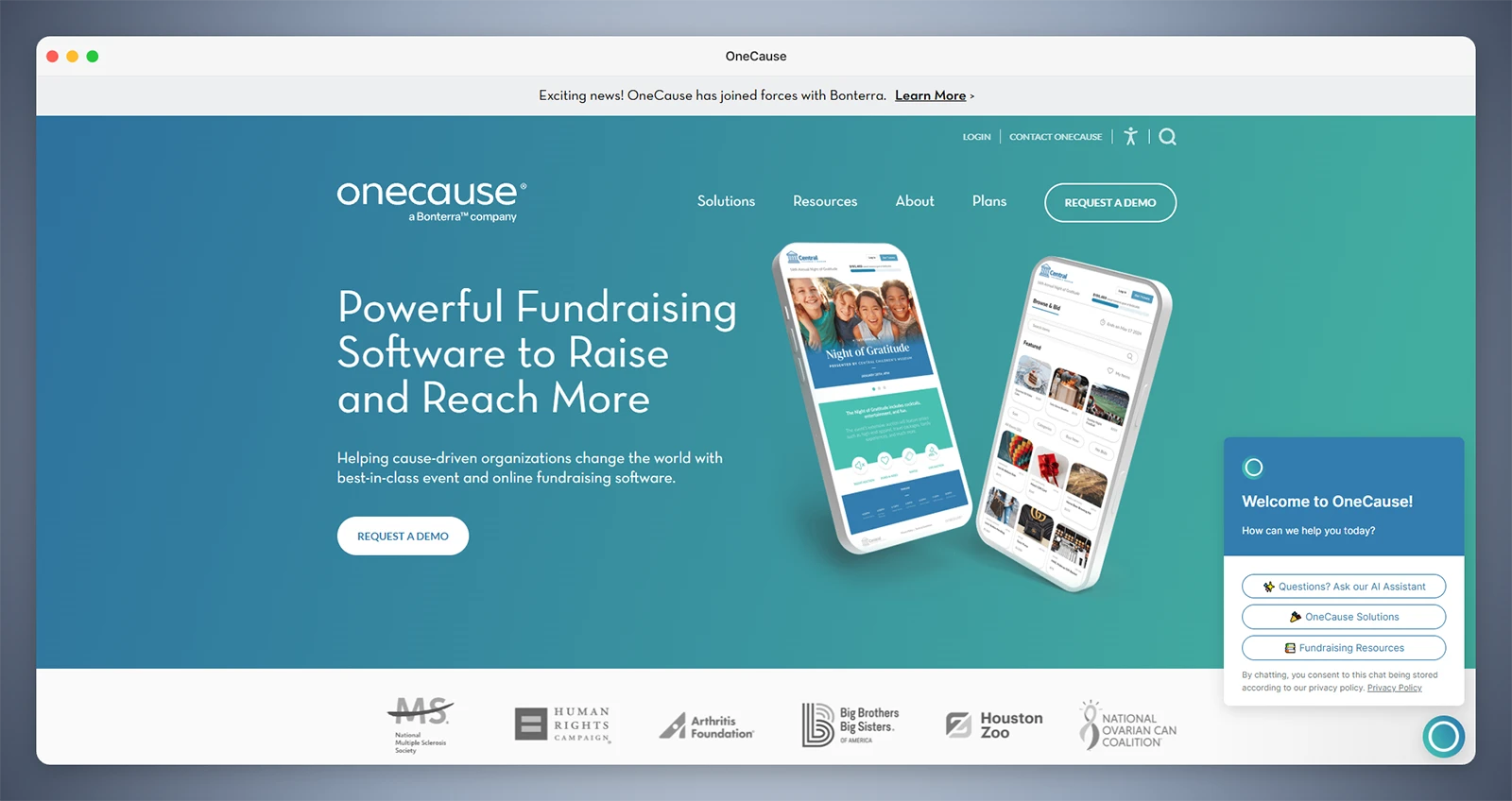
OneCause, now part of Bonterra, is the most recognized name in nonprofit event fundraising. It covers mobile bidding, ticketing, table management, fund-a-need, peer-to-peer and year-round giving, and it is one of the few vendors that still sends staff to events.
Product Overview
OneCause is a full event platform. It gives you event giving sites, integrated ticketing and table management, online sponsorship sales, express check-in, silent and live auction bidding, scoreboards and slideshows for the room, and peer-to-peer campaigns for the rest of the year.
OneCause is a good fit for organizations that want one vendor across events and campaigns and value a trained person in the room.
Pricing
Pay-as-you-go starts at $200 per event with a 5% platform fee on funds raised, which OneCause says is capped, and the Professional Auction and Event package is $2,995 per year. Enterprise and multi-chapter pricing is quoted. Payment processing is charged on top, with review sites reporting rates from about 2.9% + $0.30 to roughly 4% per transaction, and on-site event staffing is an additional service. For a $200,000 gala that puts the realistic total at $11,000 to $14,000 once a staffer and processing are included, against a $2,995 headline.
Raiser's Edge NXT Integration
Not a native sync. OneCause lists Raiser's Edge NXT as an integration, but the integration is Importacular for OneCause, a plug-in from Zeidman Development that runs inside the Raiser's Edge database view.
Your database team exports event data from OneCause, then imports it through Importacular using a saved mapping to constituents, gifts, funds and appeals.
It removes hand-keying, but it is still an export-and-import step your database team runs after the event, which is why Blackbaud Community users describe flat files going back and forth and why reconciliation on OneCause is measured in weeks rather than hours.
Ask OneCause to show the workflow end to end before you sign, and count the steps between a winning bid and a gift record.
Setup
Sales-led, with a dedicated onboarding path. Plan six to ten weeks for a first gala, longer if you are migrating from another platform.
Tradeoffs
OneCause is priced for organizations running a full event calendar, and teams running one gala a year sometimes find modules like peer-to-peer priced in but unused. The integration depth with Raiser's Edge NXT is the most common objection we hear from Blackbaud customers, and we are increasingly hearing that attendees are frustrated with its messaging system.
G2 rates OneCause 4.7 out of 5 across roughly 500 reviews, and reviewers consistently praise support. If on-site staffing is a requirement, this is the strongest platform in the guide for it. Read our detailed comparison at Trellis vs OneCause.
#3
GiveSmart
Best All-in-One With Donor CRMFundraising Tech Score: 5.7/10
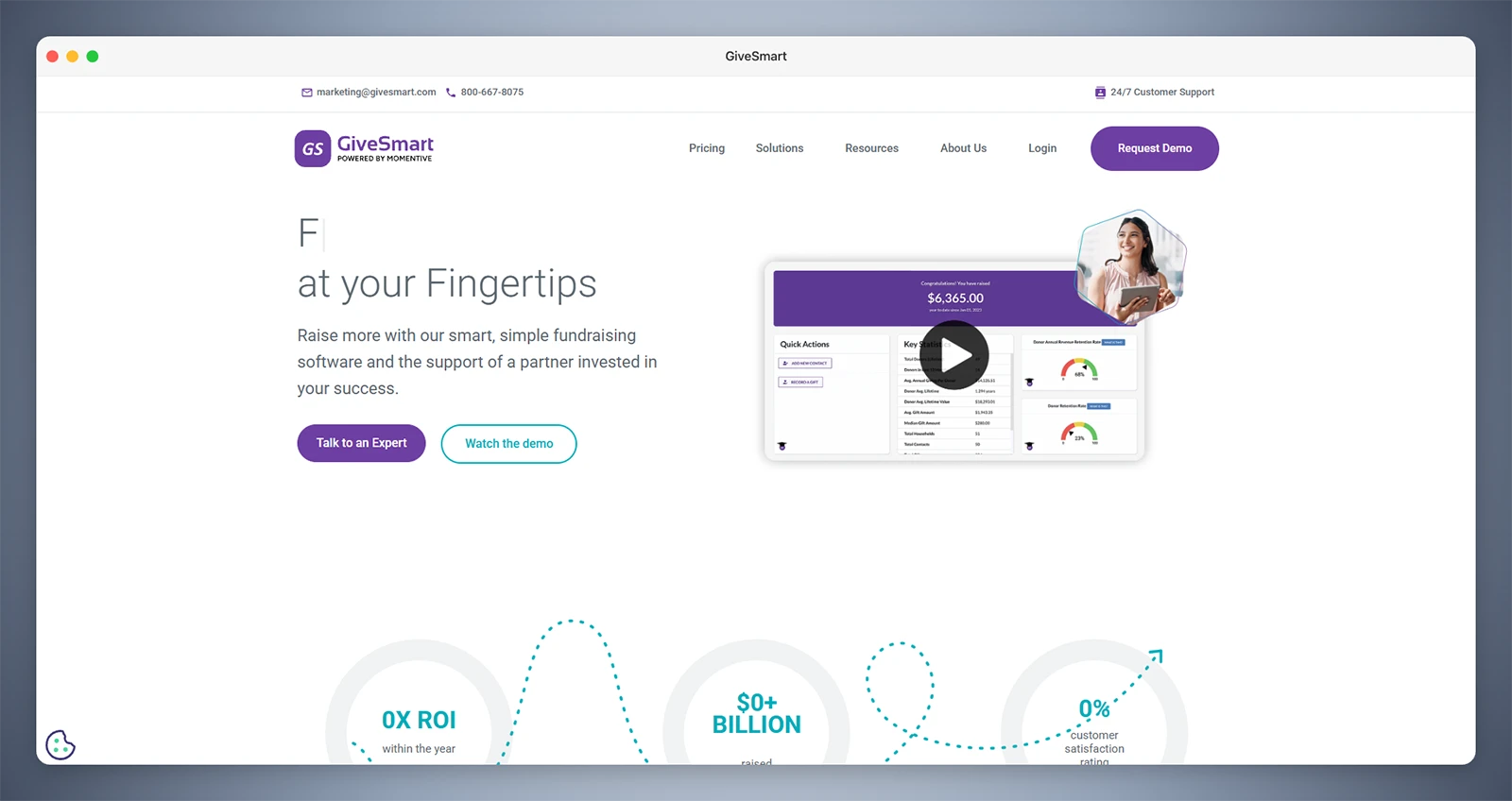
GiveSmart, from Momentive Software, is an all-in-one fundraising, event and donor management platform, and one of the four vendors Raiser's Edge NXT gala buyers most often shortlist. Mobile bidding, events, campaigns and a built-in donor CRM sit under one contract.
Product Overview
GiveSmart runs mobile bidding and silent auctions, event ticketing with seating, fund-a-need, text-to-give, peer-to-peer and livestream integrations, and it includes a donor CRM with DonorSearch scoring built in. GiveSmart absorbed the former 501 Auctions and Gesture products and is positioned as one contract, one contact and one support team for the whole fundraising year.
Pricing
GiveSmart publishes two models. The annual subscription is listed at about $3,000 per year with credit card processing at 3.5% (3.95% for American Express). Pay-As-You-Go has no annual fee and a higher all-in processing rate disclosed at signup. On a $200,000 gala the processing line alone is about $7,000, so the all-in cost is roughly $10,000 before setup or add-ons. There is no free trial.
Raiser's Edge NXT Integration
Not a native sync. GiveSmart lists Blackbaud Raiser's Edge among its CRM integrations, but the documented path is Importacular NXT, a third-party import tool from Zeidman Development that names GiveSmart as one of its data sources. It is an import after the event, not a sync during it.
Constituent, address and gift imports are free in Importacular; other record types and automation carry a subscription. In practice the database team pulls GiveSmart data into Raiser's Edge NXT through that tool and maps funds and appeals there, so attribution and de-duplication are configured outside GiveSmart. Confirm whether event participation records are created at all.
Setup
Sales-led onboarding, six to eight weeks for a first gala with assisted migration.
Tradeoffs
Reviewers who have used GiveSmart for a decade praise having every event's history in one place and raise two recurring points: pricing rises at renewal, and onsite staffing, once a selling point, is no longer a standard offering (GiveSmart's help center lists an emergency after-hours phone line for event night). Some wish the CRM connectors went deeper.
G2 rates GiveSmart 4.5 across roughly 160 reviews and Capterra 4.5 across about 200. For a team that wants a donor CRM and gala software from one vendor and is not on Raiser's Edge NXT, it is the most complete package here.
#4
Greater Giving
Best for Volunteer-Run Check-InFundraising Tech Score: 4.9/10
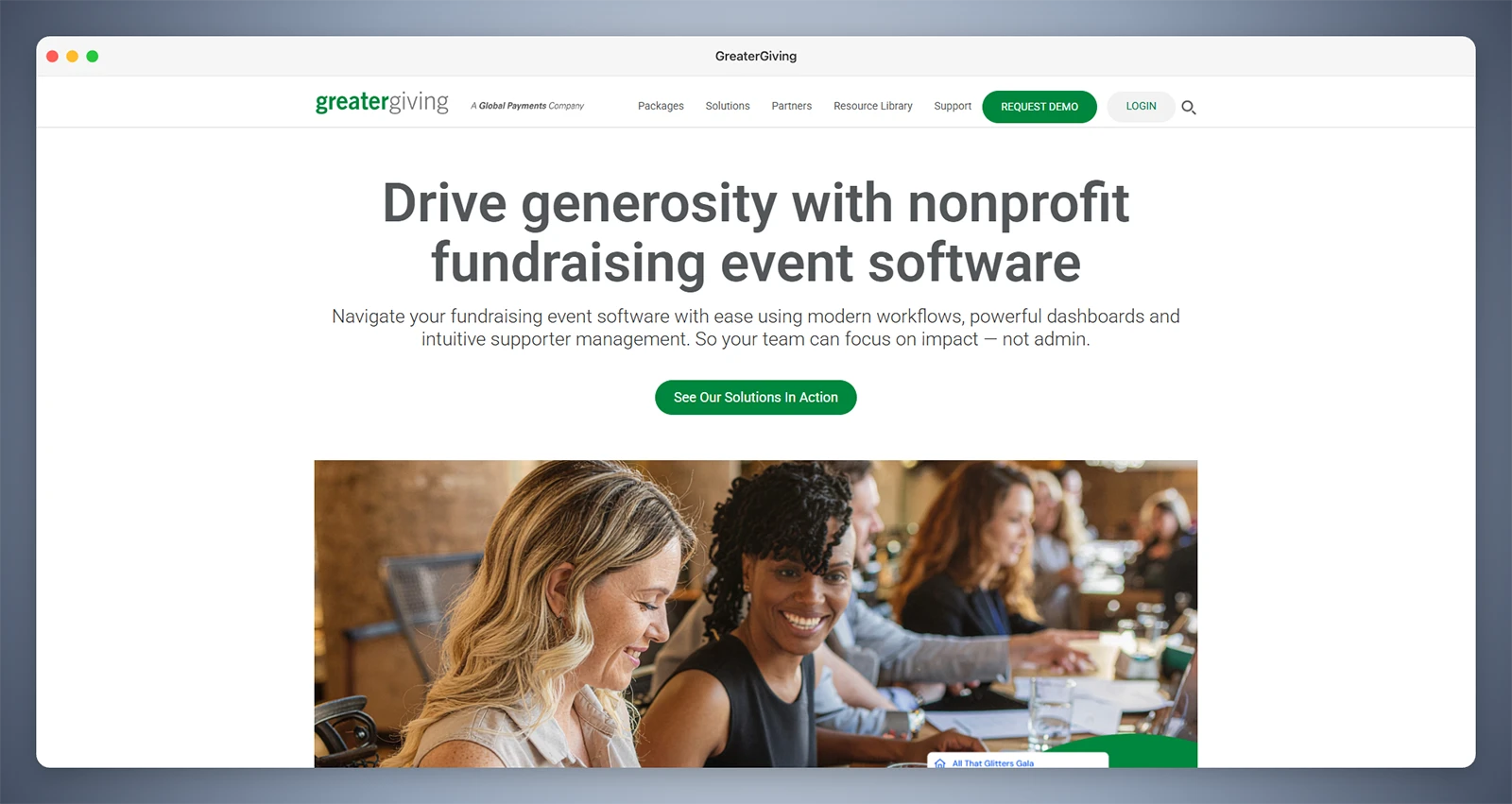
Greater Giving, a Global Payments company, has run school and nonprofit auctions since 1983 and is another of the four platforms Raiser's Edge NXT buyers most often compare against Trellis. Its Go Time event-night interface and Auctionpay card terminals are built so volunteers can run check-in and checkout with almost no training.
Product Overview
Greater Giving's event software covers auctions, galas and golf tournaments. It handles online bidding, ticketing and registration pages, sponsor and donor tracking, event-night check-in and checkout through Go Time on laptops and tablets, card payments through its Auctionpay readers, itemized receipts printed at the event, text-to-donate and video streaming. Packages cover unlimited users and events.
Pricing
Quote only. Greater Giving sells annual Event, Express and Virtual and In-Person packages with unlimited users and events and no setup fee. The model is a baseline annual fee plus card processing on volume through Global Payments and proprietary Auctionpay card terminals, and Greater Giving positions itself for organizations with event budgets of $50,000 or more.
Raiser's Edge NXT Integration
Export and import only. Greater Giving states that its event software exchanges donor data with Raiser's Edge, eTapestry and other donor databases, and that exchange is a file export from Greater Giving followed by an import on the Raiser's Edge side.
There is no constituent-level matching inside Greater Giving, no fund or appeal mapping applied at the moment of sale, and no event participation sync. Everything the platform captures on the night reaches Raiser's Edge NXT as a batch your database team maps and de-duplicates afterward.
Setup
Sales-led, about one month to first event according to G2 pricing insights, with volunteer training on Go Time typically a single session.
Tradeoffs
Ease of use is the weakest score in Greater Giving's reviews, with Capterra rating it 4.4 across 100 reviews and ease of use at 3.9, while support scores 4.7.
Reviewers describe an interface that has been improving for years but still takes time to learn, and note the absence of a combined thank-you letter across tickets, sponsorships and purchases. Proprietary hardware is a strength on the night and a cost line on the invoice.
On-site staff is available for larger galas. G2 rates Greater Giving 4.2 across roughly 100 reviews.
#5
Givebutter
Free Online Campaigns and Small EventsFundraising Tech Score: 4.8/10
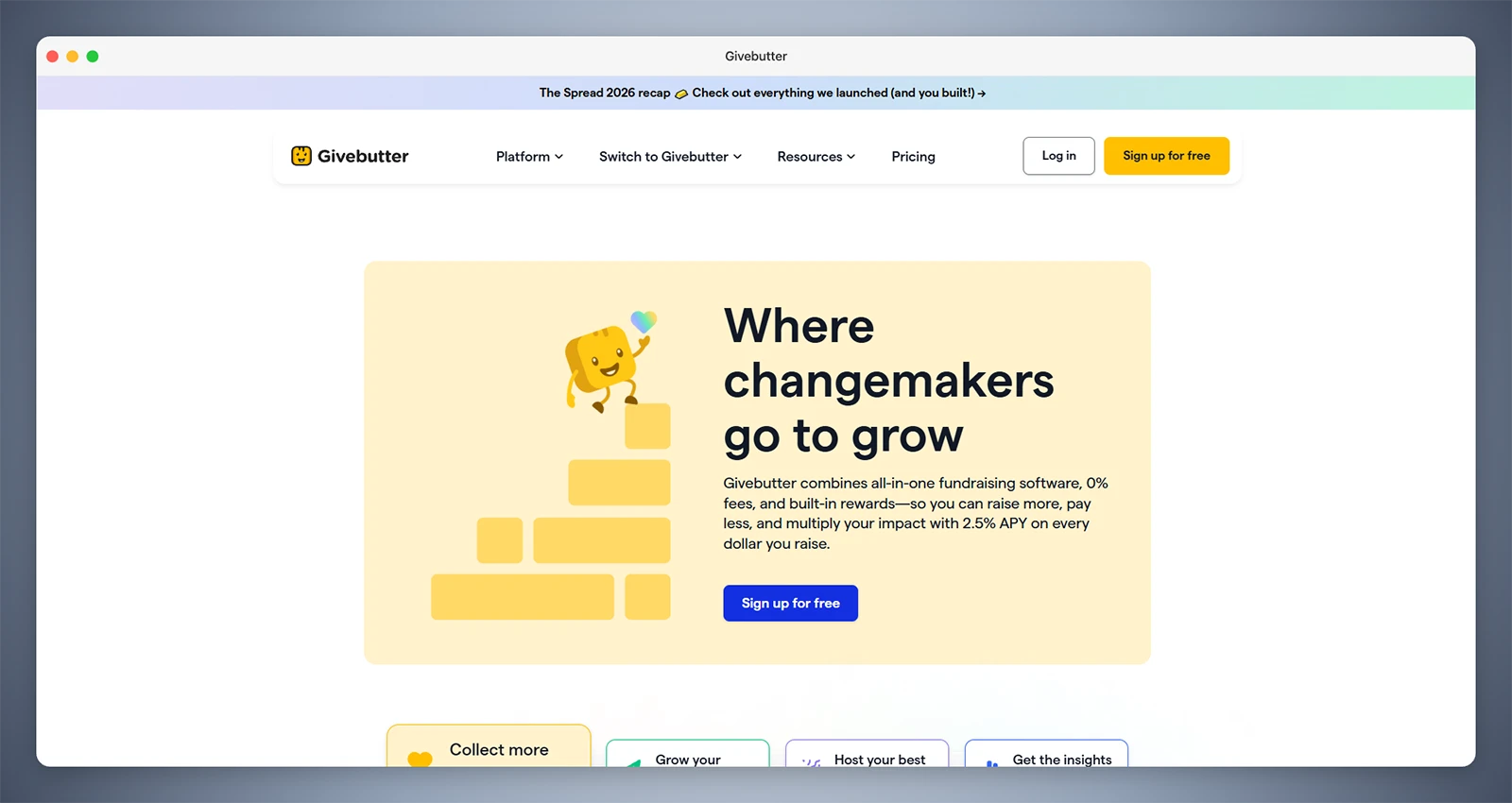
Givebutter is a free all-in-one fundraising platform with donation forms, peer-to-peer, ticketing, auctions and a built-in CRM, funded by optional donor tips. It was named G2's top nonprofit software of 2026.
Product Overview
Givebutter gives you event pages with unlimited ticket types, check-in scanning, in-person payments and livestream, plus silent auctions with mobile bidding, automated bidding and auto-charge for winners. The CRM is included free with unlimited contacts. Gala mechanics such as table assignment and paddle raise controls are lighter than the dedicated event platforms.
Pricing
Free to the nonprofit when donor tips are enabled. The money comes from your guests: Givebutter suggests a tip to the platform at checkout, defaulting to about 15%, and separately asks donors to cover processing fees, which Givebutter says around 95% of donors agree to. Disable tips and a platform fee applies: a flat 3% on Standard pricing for accounts created since 2025, or 1% for forms, 3% for pages and 5% for events and auctions on Legacy pricing.
Processing is 2.9% + $0.30 per card transaction when tips are off. In June 2026 a class action was filed in Pennsylvania (McClintock v. Givebutter) alleging that fees were added to online donations without donors' knowledge or consent. The case is pending and the allegations are unproven, but it is worth knowing before you put a tip prompt in front of a $5,000 table buyer. Givebutter Plus adds workflows, texting and reporting from $29 per month.
Raiser's Edge NXT Integration
Not native, and not free. Givebutter's Raiser's Edge NXT integration is powered by Omatic, a third-party integration platform with its own subscription, so the free platform's CRM sync is a paid add-on from another vendor that customers tell us typically costs thousands of dollars a year.
Omatic can map Givebutter custom fields and push donations into Raiser's Edge, and it is a capable tool.
What it is not is a Givebutter-native constituent and gift sync: as of 2025, gift sync with campaign, fund and appeal mapping was still an open request on Givebutter's own community board. Budget for Omatic and for the mapping work before you assume the free platform reconciles itself.
Setup
Self-serve, same day. A first event can be live within an hour.
Tradeoffs
The free model works because guests tip, and at a gala where a table buyer pays $5,000 that tip prompt can read differently than on a $50 donation. Event platform fees apply the moment you auto-charge auction winners. Reconciliation into Raiser's Edge NXT remains partly manual.
Capterra rates Givebutter 4.8 across roughly 870 reviews and G2 4.7 across more than 2,000. For online campaigns and smaller ticketed events it is hard to argue with the price.
#6
Bloomerang Fundraising
Best for Bloomerang CRM UsersFundraising Tech Score: 4.8/10
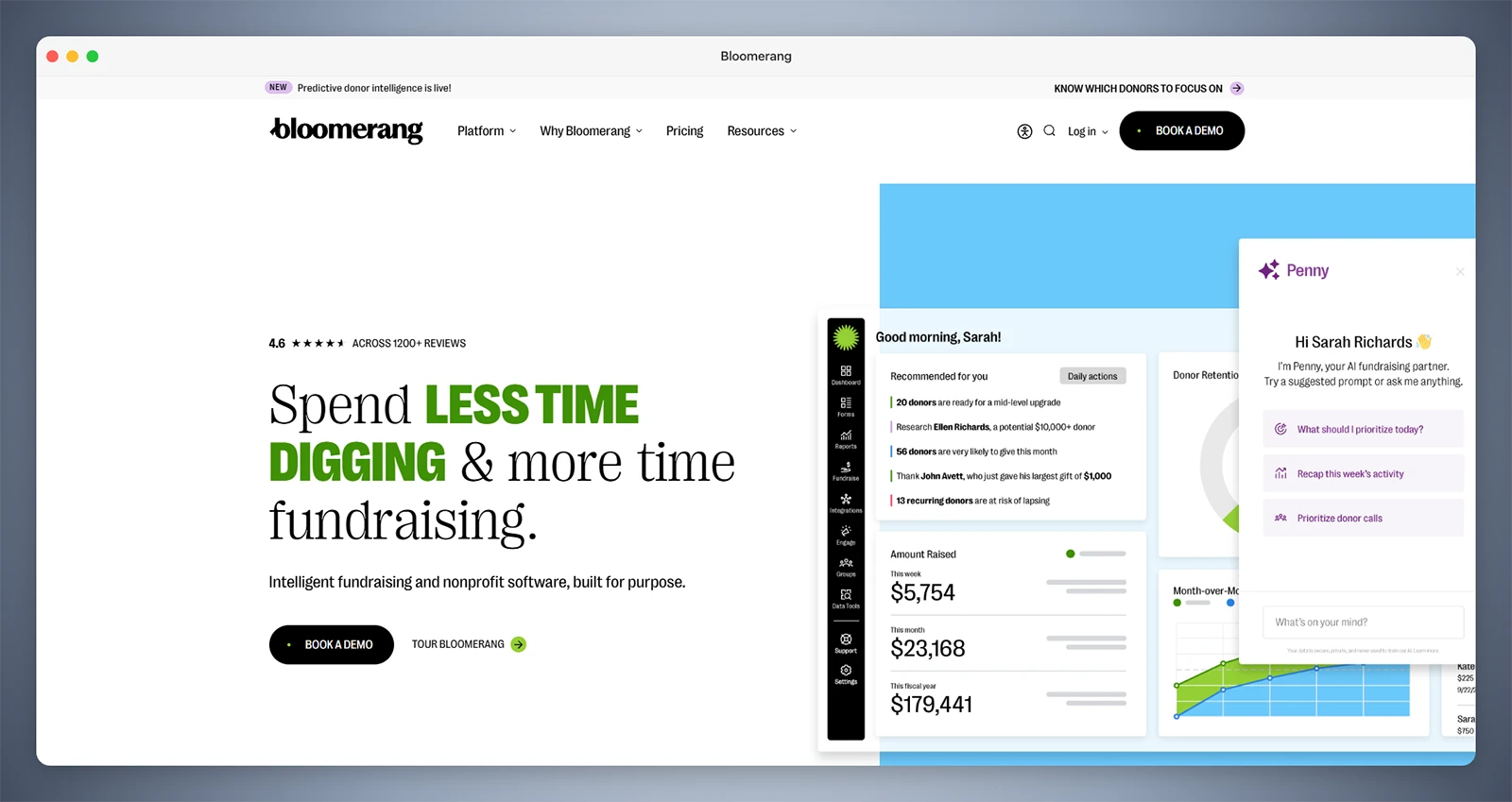
Bloomerang Fundraising, formerly Qgiv, is the fundraising layer of the Bloomerang Giving Platform: donation forms, events, peer-to-peer, auctions and text giving built to feed Bloomerang CRM.
Product Overview
Bloomerang Fundraising covers event registration, ticketing and mobile auctions, along with fund-a-need and text fundraising. The auction and event tools sit in the Pro tier of the Giving Platform. It is a coherent choice if Bloomerang is already your donor database.
Pricing
Bloomerang Fundraising starts at $40 per month billed annually for forms, events and text giving. Auctions, peer-to-peer and outbound text sit in the Pro tier, which is quote only. Bloomerang CRM is $125 per month. Processing fees apply on top, with Qgiv's published processing rates at 2.95% to 3.95% + $0.30 depending on plan.
Raiser's Edge NXT Integration
Not native. Bloomerang Fundraising offers a Raiser's Edge connection through Omatic's ImportOmatic, a paid third-party tool.
You set an export start date and default fund, campaign, appeal and event values in Bloomerang Fundraising, and ImportOmatic pulls the transactions into Raiser's Edge, with packages required to match event price units exactly.
It works, and it is more than most free tools offer, but it is a scheduled export mapped by defaults, and Bloomerang's commercial position is to replace Raiser's Edge rather than to feed it.
Setup
Days for donation forms, a few weeks for a first event with auction.
Tradeoffs
Everything routes through Bloomerang CRM, which is the point if you use it and the problem if you do not. Some reviewers describe event-night reliability issues on the legacy Qgiv auction tooling and paid card readers; Bloomerang's acquisition has been rebuilding this. Capterra 4.6 across about 60 reviews for the fundraising product, G2 4.7 across roughly 280 reviews under the Qgiv name.
#7
Givergy
Best for Fee-Funded Events With StaffingFundraising Tech Score: 4.7/10
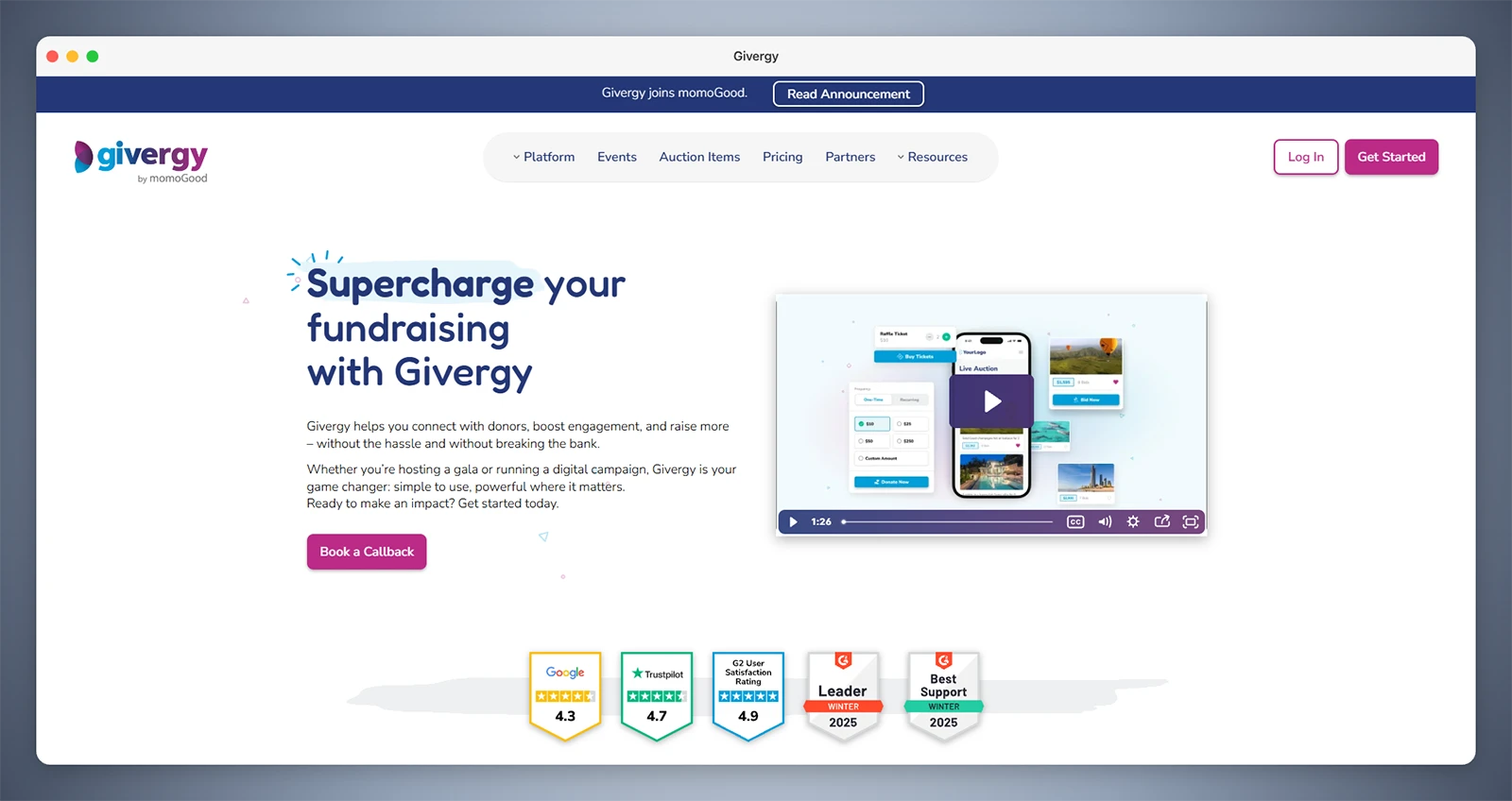
Givergy, now part of momoGood, is a UK-founded event fundraising platform with mobile bidding, leaderboards and totalizers, prize draws and ticketing, and it bundles fundraising consultation, event staffing and consignment auction items alongside the software. It is the fourth of the platforms Raiser's Edge NXT buyers most often weigh against Trellis.
Product Overview
Givergy runs silent and live auctions with mobile bidding and sealed bids, pledge appeals with bespoke totalizers and leaderboards for the room, prize draws, ticketing, donations and guest messaging. After close it sends a losing-bid conversion message to unsuccessful bidders, which Givergy reports raises an average of about $700 per event. Unlimited campaigns are included.
Pricing
Two published models in the US. A flat 4% platform fee on total funds raised, or a donor tip model where supporters cover the fee at checkout and the platform is free to the organization. Payment processing fees apply on both, and Givergy's Canadian terms also show a per-transaction ticketing fee, so ask for the full US fee schedule in writing. Event staffing, consulting and item procurement are quoted separately.
Raiser's Edge NXT Integration
A connector, not a native sync. Givergy's US site advertises syncing donor data to Raiser's Edge NXT through Givergy Connect, while Capterra lists Blackbaud Financial Edge NXT (the accounting product) as its only integration. We could not verify constituent-level matching, fund or appeal mapping, or event participation records, so treat it as a data push to confirm in a demo rather than a real-time sync, and expect the matching and attribution to land with your database team.
Setup
Weeks, consultant-led. Givergy's model pairs each campaign with a fundraising consultant.
Tradeoffs
Review volume in the US is thin, and Trustpilot reviews are mixed, with a Trustpilot score around 4.1 and several reviews describing equipment or features that failed on the day and others praising responsive support.
The percentage model means a $500,000 gala pays $20,000 in platform fees unless tips cover it, which is the tradeoff of no upfront cost. For a team that wants staff in the room and a losing-bid prompt without an annual contract, it fills a gap the others leave.
#8
Zeffy
Zero Fee to the NonprofitFundraising Tech Score: 4.3/10
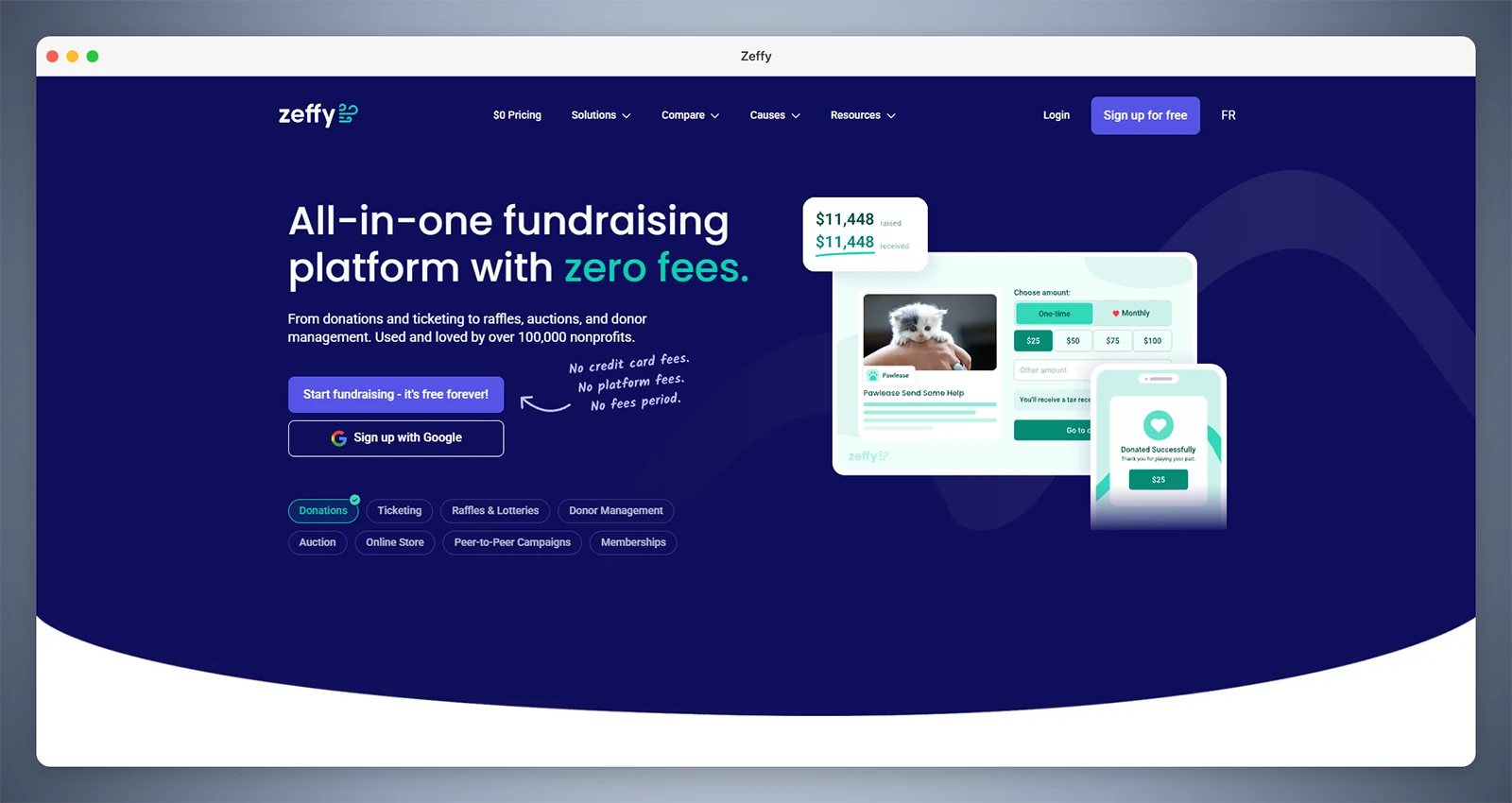
Zeffy is the only platform in this guide with no platform fee and no processing fee charged to the nonprofit. It is funded entirely by donor contributions at checkout, and the contribution to Zeffy is pre-selected at 17% on transactions under about $100 and 15% above that.
Product Overview
Zeffy covers ticketing with check-in, online and in-person auctions with outbid notifications, raffles, donation forms, memberships and a basic donor CRM. Guests bid via link or QR code with no app. It is built for small teams hosting their first events.
Pricing
$0 to the nonprofit. Zeffy covers card and transaction fees and pre-selects a contribution to Zeffy at checkout: 17% on gifts under about $100 and 15% above, which the donor has to actively reduce or remove. Zeffy says about two in three donors leave it in. Zeffy's own feedback board carries repeated requests from nonprofits to default the contribution to $0 because donors did not notice it, and the tip percentage is a recurring complaint in its G2 reviews. More than 100,000 nonprofits use it.
Raiser's Edge NXT Integration
No Raiser's Edge NXT integration. Zeffy connects to other systems through Zapier and exports to Excel and Google Sheets; there is no Blackbaud connector.
A Zapier build can create constituents, but gift-level records with fund and appeal attribution and event participation are beyond what the connector supports, so every gala transaction reaches Raiser's Edge NXT as a manual or semi-manual import.
Setup
Under an hour. Zeffy customers regularly report selling tickets within 30 minutes of signup.
Tradeoffs
Free to you is not free to your guests: a $5,000 table buyer is asked for a $750 contribution to Zeffy on top of the table. The model depends on those contributions, and there is no phone support tier or dedicated rep on event night. Gala-specific mechanics such as table management, paddle raise controls and overtime bidding are limited. Capterra rates Zeffy 4.8 across roughly 480 reviews. For an organization that does not need CRM-level data integrity and is comfortable with the tip prompt, the price is unbeatable.
#9
RSVPify
Best for Registration-Only EventsFundraising Tech Score: 4.1/10
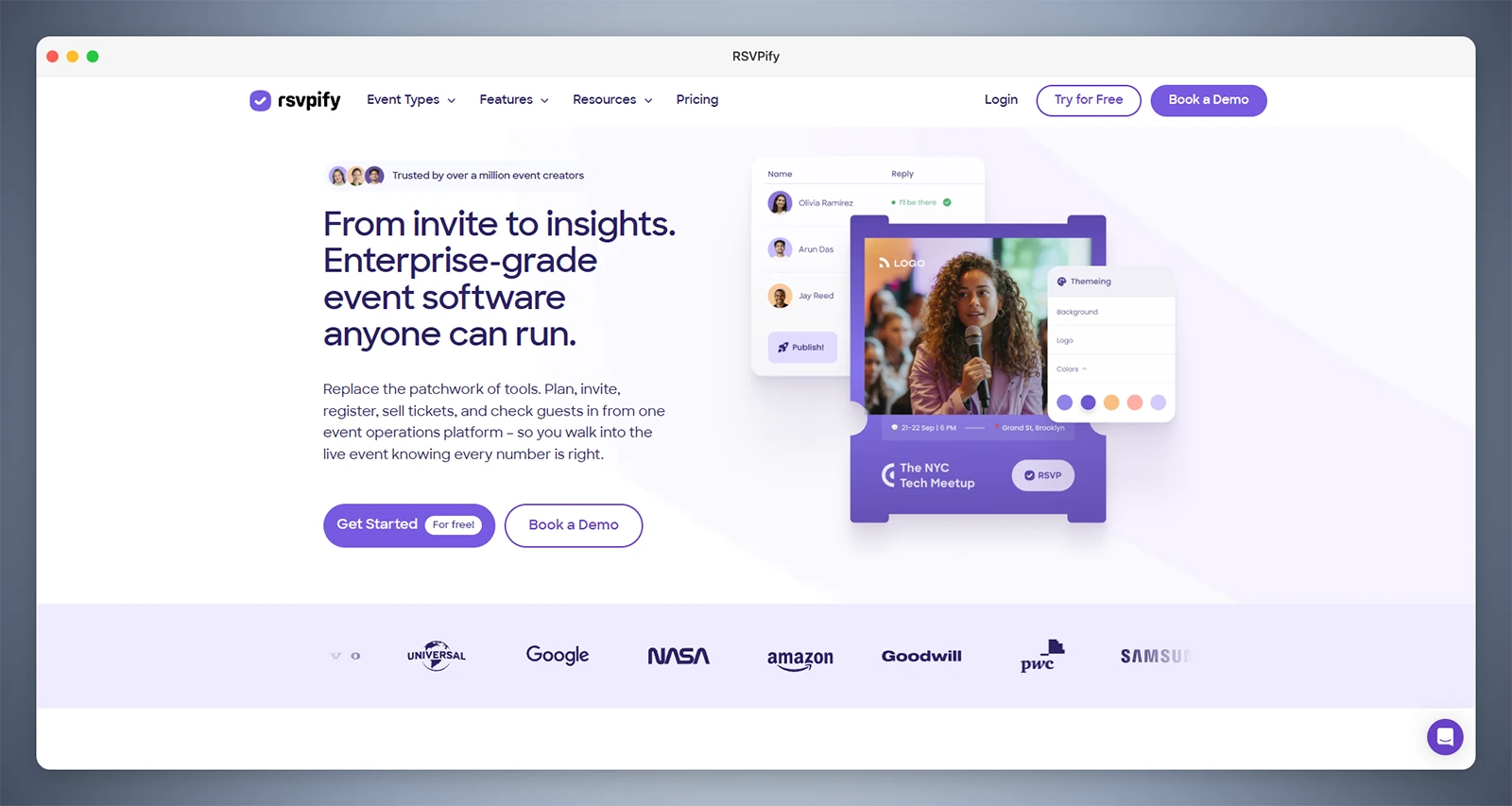
RSVPify is an event registration and ticketing tool used for galas, weddings and corporate events. It excels at invitations, seating charts and check-in, and it is not a fundraising platform.
Product Overview
RSVPify handles branded invitations, conditional RSVP questions, meal preferences, a seating chart builder, table and ticket sales, sponsorship payments and QR check-in. There is no auction, paddle raise or donor CRM.
Pricing
Free for up to 100 registrations. Business and Nonprofit plans run $39, $125 and $409 per month, or $24, $89 and $299 billed annually, with a 20% nonprofit discount on annual plans. Ticketed events pay 1.95% + $0.90 per ticket, item or donation on top of Stripe processing at 2.9% + $0.30; nonprofits get a discount on annual plans.
Raiser's Edge NXT Integration
No Raiser's Edge NXT integration. RSVPify exports registration and ticket data as spreadsheets and offers native integrations only on its Enterprise tier, none of which is a Blackbaud connector. Every guest record and ticket purchase reaches Raiser's Edge NXT by import.
Setup
Same day.
Tradeoffs
Pair it with an auction tool and a donation form and you have the patched-together stack this guide is trying to help you leave. TrustRadius scores RSVPify 8.5 out of 10 and reviewers praise the seating tools. Use it for the registration layer of a non-fundraising event, not as gala software.
How We Built This Guide
We started with the buying triggers that bring people to this search. A gala date is locked and the platform is not. The last gala ended with weeks of data cleanup. The incumbent advertised a CRM integration that turned out to be an export file.
Guests could not log in on event night. The team is running one evening on five separate tools. Finance and the database administrator are pushing back on duplicate constituents and payouts that do not reconcile.
We then verified pricing against each vendor's published pricing page or review-site listing in September 2026, read each vendor's integration documentation to separate a constituent-level sync from a file exchange, and used G2, Capterra and the Blackbaud Community only for recurring patterns rather than single complaints. The scoring weights are above. Where we could not verify a claim, we left it out.
This guide is for a Director of Development and an events coordinator reading together, with a database administrator checking the integration claims over their shoulder. It should let you shortlist two platforms, run one vendor call per platform with the right questions, and confirm the reconciliation path before you sign.
What Features to Look For in Fundraising Gala Software
Every gala platform lists the same features on its pricing page. We measured each product against the problems those features are supposed to solve, in the order the scoring weights rank them.
1
Native Constituent-Level Sync Into Raiser's Edge NXT
If your last gala ended with a CSV import, look for a platform that writes constituent and gift records directly into Raiser's Edge NXT with campaign, fund, package and appeal mapping applied at sync.
Ask the vendor to show you a winning bid landing on a constituent record with the right appeal attached. Only Trellis, our own platform, does this natively among the nine here.
2
No-Login Mobile Giving
If guests abandoned bids at the password screen, look for a text link that opens the guest's account with no username, password or app download. Test it yourself on a phone from a different carrier before you buy, and ask what happens when a guest's details are missing.
3
One System for Every Revenue Type
If tickets, auction and door sales lived in three tools, list every revenue type your gala sells: individual tickets, tables, VIP tiers, sponsorships with and without tickets, silent auction, live auction, paddle raise, raffle and add-on items. Then confirm the platform handles each one natively, not through an add-on or a partner.
4
A Support Model That Matches Your Team
If your volunteers were untrained on the night, decide whether you want vendor staff in the room or a platform your own volunteers can run with no prior training. OneCause and Greater Giving sell event staffing as an add-on, Givergy bundles it with consulting, and GiveSmart's standard event-night support is an emergency phone line rather than people in the room. Know what you are buying: the people vendors send are usually junior event staff, not engineers, and customers tell us they often cannot fix a problem on the night. Price that honestly against a platform built not to break.
Trellis is built so staff walk in and it works, with onboarding reserved for the core team and 99.99% uptime behind it. Both approaches work; they cost differently and leave your team in a different place the following year.
5
Fee, Receipting and Payout Handling Finance Can Sign Off On
If Finance could not reconcile last year's deposits, ask who absorbs processing fees, how fair market value is split from the donation portion on tax receipts, and how batches and payouts are tracked. Run this with your database administrator before the contract, not after the gala.
6
Published Pricing for the Whole Gala
If you are building next year's budget, price the platform fee, processing fees, per-event versus annual terms, implementation charges, paid add-ons and onsite staffing together. Three of the nine platforms in this guide publish no starting price; Trellis publishes a flat $5,000. Ask each vendor for the full number in writing, including processing, before you shortlist.
Fundraising Gala Software Pricing Comparison
Gala software is two or three line items, and most budgets only account for one. The platform fee is what the vendor charges. Processing fees are what the card networks and Stripe take. Optional tips are what your guests are asked to add. A "free" platform recovers its cost through the third line, and a subscription platform through the first.
Six pricing models appear in this guide. A flat annual fee with 0% transaction fees on eligible checkouts under $3,000 (Trellis). Quote-based packages (GiveSmart, Greater Giving). Annual subscription or pay-per-event with a 5% platform fee (OneCause). A percentage of funds raised (Givergy). Free to the nonprofit with a pre-selected donor tip, converting to a percentage platform fee when tips are off (Givebutter, Zeffy, and Givergy's tip model). Monthly subscription plus per-ticket fees (Bloomerang Fundraising, RSVPify). Free to the nonprofit means the fee is charged to your guests; on Zeffy the default ask is 15% to 17%.
Pricing as of September 2026. Contact each vendor directly for current information.
What a $200,000 gala actually costs
Headline prices hide most of the bill, so here is the all-in estimate for each platform on a $200,000 event, using each vendor's published fees and the processing rates review sites report. Verify against your own quote before you sign.
-
Trellis: $5,000, and with 0% fees on the total usually stays very close to $5,000, because few checkouts run above $3,000. Flat annual fee; 0% transaction fees on eligible checkouts under $3,000; sponsorships and lots above $3,000 at 3.5% + $0.30 (about $2,450 if $70,000 of the gala comes in over that line); no onsite staffing charge. Roughly $12,000 with 0% off.
-
OneCause: roughly $11,000 to $14,000. $2,995 Professional package, 3% to 4% processing (about $6,000 to $8,000), plus a quoted onsite staffer that customers tell us runs $2,000 or more. Pay-as-you-go is higher: the 5% platform fee alone is $10,000 before processing.
-
GiveSmart: roughly $10,000. About $3,000 annual subscription plus 3.5% processing (about $7,000).
-
Greater Giving: quote plus processing. A baseline annual package plus card processing on $200,000 of volume, which at typical rates adds $6,000 or more.
-
Givebutter: $0 to you with tips on, with your guests asked to tip Givebutter about 15% at checkout and to cover processing. Tips off: 3% platform fee ($6,000) plus 2.9% + $0.30 processing (about $5,800), roughly $11,800 on Standard pricing, or roughly $15,800 on Legacy event pricing at 5%.
-
Bloomerang Fundraising: roughly $6,400 to $8,400 plus the Pro tier quote. $480 a year plus 2.95% to 3.95% processing ($5,900 to $7,900); auctions require the quoted Pro tier.
-
Givergy: $8,000 at the 4% platform fee, plus processing, or $0 to you if donors cover it through tips.
-
Zeffy: $0 to you. At the 15% default contribution, your guests are collectively asked for up to $30,000 in contributions to Zeffy on $200,000 of transactions.
-
RSVPify: not comparable. Registration and ticketing only; you still need an auction and donation tool.
The pattern is consistent: the platforms that look cheapest on the first line cost the most once processing, platform percentages or donor tips are counted, and the one with the highest headline number is usually the lowest total. Then add the cost nobody budgets: two to five weeks of a database administrator's time after every event on an export-based platform, versus one day.
FAQs
Which gala platforms integrate with Raiser's Edge NXT?
Trellis, our own platform, is the only gala software with a native Raiser's Edge NXT integration that writes constituent-level and gift-level records with campaign, fund and appeal mapping.
OneCause and GiveSmart move data through Importacular, a third-party import plug-in, Givebutter and Bloomerang Fundraising rely on Omatic's paid tools, and Greater Giving exports a file for import. Givergy advertises a Raiser's Edge NXT connector whose depth we could not verify, and Zeffy and RSVPify have no Raiser's Edge NXT integration at all.
Which software for running a fundraising gala offers one platform that handles tickets, sponsorships, silent auction and paddle raise?
Trellis, OneCause, GiveSmart, Greater Giving and Givergy all run tickets, tables, sponsorships, check-in, silent auction and paddle raise in one system. Givebutter covers ticketing and auctions but not paddle raise controls or table management. Zeffy handles tickets and auctions. RSVPify handles registration and seating only, so it needs a separate auction and donation tool.
How long should post-gala reconciliation take?
The same night or the next day on a native sync. Gifts are attributed in Raiser's Edge NXT by the time the room empties, and the database administrator's job is a review rather than a rebuild. Grace Christian School completed three weeks of former post-event work in one day on Trellis. On export-based platforms, two to five weeks is typical for a 400-guest gala, and some teams report six or seven.
How long does it take to set up Trellis before a gala?
We can move as fast as you can. On average, one to two weeks to set up banking, the Raiser's Edge NXT integration and your first event. The rest of your runway is ticket sales. Setup is self-guided with in-product tutorials and our team available at every step, and mapping is done once and carries to every future event.
Do guests need an app or a login to bid in a silent auction with Trellis?
No. Guests receive a text with a no-login link that opens their account instantly, with no username, password or app download. Bidding, outbid alerts, paddle raise prompts and check-in confirmations all happen by text. Guests with incomplete records can pledge with a name and email, and their details are completed and matched in Raiser's Edge NXT afterward.
How much does fundraising gala software cost in 2026?
Anywhere from free to the nonprofit to several thousand dollars a year, and the headline number is rarely the real one. Zeffy is free to the nonprofit and funded by a donor tip pre-selected at 15% to 17%. Givebutter is free with tips, or a 3% platform fee plus 2.9% + $0.30 without. OneCause runs $200 per event plus a 5% platform fee, or $2,995 per year, plus processing and quoted onsite staff.
GiveSmart is about $3,000 per year plus 3.5% processing, Greater Giving is quote only, and Givergy charges 4% of funds raised or nothing when donors tip. Bloomerang Fundraising starts at $40 per month plus processing. Trellis is a flat $5,000 per year with a 0% transaction fee option. On a $200,000 gala, Trellis is usually the lowest total cost in this guide. Always price the whole gala, not the platform fee.
What is the best gala software for small nonprofits?
For an organization under 150 guests without a CRM to feed, Zeffy or Givebutter will run the night at no cost to you, with your guests covering the platform through tips.
Once your gala is a meaningful share of annual revenue and the results need to land in Raiser's Edge NXT, the reconciliation time saved by Trellis, our own platform, tends to outweigh the platform fee.
OneCause, Greater Giving and Givergy suit small teams that want vendor staff on site.
500+ galas · $150M+ raised
Close the gala and the reconciliation on the same night
See how Trellis writes every ticket, sponsorship and winning bid into Raiser’s Edge NXT in real time.
“My team doesn’t dislike me anymore.” — Trellis customer