A Raiser’s Edge integration that cut data entry from eight hours a week to one, $14,000 in revenue from two features they almost passed over, and a gala night staffed by students with five minutes of training.
Every advancement team has a version of the same problem. The platform you’ve been using for years isn’t quite failing; it’s just fraying around the edges. Customer support has gotten slower. Manual data entry after each event has become something you just budget time for. The fees are higher than they should be, but switching feels risky, and the calendar is always too full to make it the year you finally deal with it.
The workarounds become invisible because you’re the one doing them. Hours of data entry feel normal when they’ve always been there. Waiting on hold for support feels normal when there’s no other option. Paying a vendor to staff your event feels like a safety net, not a cost, until you stop and think about what it’s actually insuring against.
For the advancement team at The John Cooper School, a pre-K through 12th independent school in Texas, these pressures had been accumulating for years. The school manages a full event calendar, a fall golf tournament, a December author series luncheon, and a spring gala that has now crossed the million-dollar mark — with a small, talented team carrying significant operational weight. They had worked their way through Greater Giving, Bidding for Good, and BidPal before landing on One Cause, where they had stayed for a long time. But when One Cause was acquired by Bonterra and customer service shifted to an AI-driven model, something clarified.

Hannah Beard, Administrative Assistant, The John Cooper School
When your support line starts costing you more than it saves
The frustration wasn’t a single incident. It was a pattern. Hannah Beard, the Administrative Assistant who managed much of the event’s back-end logistics, found herself routinely solving her own problems before help arrived.
“I would find that when I would call them and be put on hold, I would usually find my answer before they even came back on the line. Sometimes they would have to escalate, and that would take two days.” — Hannah Beard, Administrative Assistant, The John Cooper School
For Katherine Donovan, the school’s Advancement Services Manager, the drain was quieter but more constant. Every ticket sale, every auction win, every donation arrived from the event platform as an email notification, and then she manually entered each one, one by one, into Raiser’s Edge. Six to eight hours a week, during event season, going into data work that should have been automatic.
“I would do maybe six to eight hours of data entry before Trellis, and now it’s just maybe one hour a week.” — Katherine Donovan, Advancement Services Manager, The John Cooper School

Katherine Donovan, Advancement Services Manager, The John Cooper School
Neither problem was catastrophic. But together, they painted a picture of a team spending significant time and energy maintaining a system rather than running programs.
The one integration that started the whole conversation
The search for an alternative started, characteristically, with Hannah. She was the one digging through options, and the detail that stopped her was specific: Trellis integrated with Raiser’s Edge. For a school running three major events a year alongside alumni programming and multiple ongoing campaigns, that wasn’t a convenience feature. It was the thing that made every other question worth asking.
Megan Zimont, the Assistant Director of Advancement Events, was honest about one reservation: Trellis doesn’t send staff to events. Their previous platform had, and the team had grown comfortable relying on that presence.
“We used it a little bit like a crutch. There’s always this person in your corner that can fix it if you break it. But what we found is that we’re not breaking it.” — Megan Zimont, Assistant Director of Advancement Events, The John Cooper School

Megan Zimont, Assistant Director of Advancement Events, The John Cooper School
Seven onboarding meetings, covering everything from initial setup to the Raiser’s Edge connection, moved them from hesitant to confident. By the time the spring gala arrived, they weren’t just ready to run the event; they were ready to hand check-in to their students.
What it looked like when the doors opened: students, paddles, and five minutes of training
At the check-in table for the gala, high schoolers stood ready to greet guests. Not staff members, not hired event workers, but students who had received fewer than five minutes of platform training. The interface made it possible. Each guest could be pulled up by name in seconds. A lit icon showed immediately whether a payment card was on file, so students knew whether to ask the question or skip it and move faster. The paddle number sat directly beside the guest’s name; one student retrieved it while another finished the check-in, and the whole exchange took seconds.
The evening ran with features the team had chosen carefully, some of which surprised them. Anonymous bidding, which became available partway through the event, was deployed for the last-chance auction. Dual text-and-email notifications meant no one was left out, including the grandparents the team had quietly worried about. As Megan noted, even grandma and grandpa are texting now, and they can click a link directly to the auction the moment it arrives.
Then came the overtime bidding, which the team had turned on without strong expectations. They had been told the longest overtime bid on record ran about ten minutes.
Two items at The John Cooper School went for more than twenty. The first was “Cheerleader for the Day,” the chance to suit up and stand with the varsity team at Friday Night Lights. The second was quieter in premise and louder in outcome: a day with the school librarian, who is retiring. Parents didn’t bid past close for a luxury package or a weekend away. They bid for one last afternoon with a woman who had been part of their children’s lives. The two items together generated $12,000 in overtime bidding alone.

One of the quieter wins Megan noticed: moving to Trellis meant fewer questions and less confusion across the board, from parents to grandparents. When guests aren’t troubleshooting, the room gets to feel like this.
The money nobody had planned for
Overtime bidding wasn’t the only feature that exceeded expectations. The Donate My Bid option, which allows winning bidders to donate their bid amount on top of paying it, was something One Cause had never offered. The school captured several thousand additional dollars through it. Combined with the overtime bids, the two features added $14,000 in revenue the team had not budgeted, planned, or expected.
The school also saved approximately 63% on credit card fees, covered in part by donors and in part by Trellis. On a gala grossing over a million dollars, that figure has a meaningful impact on what actually reaches students and families.
What the data person got back, and what she did with it
After the event, Katherine’s work looked different. Each item had its own named appeal in Raiser’s Edge, consistent across both platforms, so a bottle of wine came in tagged as “bottle of wine” rather than a generic line item. The queries she built once now do the ongoing work. Gift types, campaigns, appeals, and funds route correctly without her touching them. During the paddle raise, she sat with her laptop in the corner of the room and used the quick entry tool to keep pace with the auctioneer in real time.
The hours she recovered didn’t go to waste. They went into acknowledgements, alumni outreach, and other programs that only people can run. The advancement team didn’t grow. It just got its attention back.
The thing that surprised them most wasn’t a feature
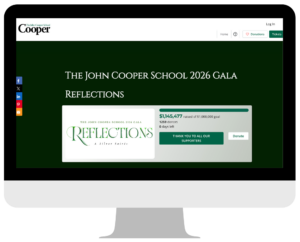
The week after the gala, the school posted the thermometer to their homepage, auction totals and paddle raise combined, in one place, in real time. ‘We knew immediately and were able to share that with our community right away,’ said Megan. The $14,000 nobody planned for is in that number.
Ask any of the three women what they’d tell a peer who was considering making the switch, and the answer is consistent. Not a specific capability, not a pricing structure, but a feeling that kept not going away: simplicity.
The advancement team at The John Cooper School spends enormous amounts of time inside databases and event management tools, working through logistics, seating, ticketing, and auction catalogs. The cognitive load is high and the margin for error is real. What surprised them most about Trellis wasn’t a single moment; it was the sustained absence of friction. Students learned it in five minutes. Grandparents navigated it without incident. The migration from One Cause, which had felt like a risk, turned out to be something the team could handle themselves.
“Everything has seemed really simple along the way, which has been a huge bonus that we didn’t know we would get.” — Megan Zimont, Assistant Director of Advancement Events, The John Cooper School
What a few months in looks like, and what it points to
In one event on Trellis, The John Cooper School made $14,000 in revenue it didn’t expect, saved 63% on credit card fees, and freed Katherine from six or seven hours of weekly data entry. The three team members who had each been carrying a different piece of the pre-Trellis operational load found themselves with something they hadn’t planned for: margin.
“Having Trellis is almost like getting a part-time employee, and one who is skilled in website creation, communications, and capturing information from your guests that you might forget to ask for. It’s been such a blessing to have a tool that functions so smoothly and so unexpectedly captures extra money that we didn’t think was even on the table.” — Hannah Beard, Administrative Assistant, The John Cooper School
The school is only a few months in, with more events on the calendar. The number they’re most curious about isn’t this year’s. It’s next year’s.
If your team is spending hours reconciling event data by hand, paying more in processing fees than you should be, or running on a platform that has stopped growing with you, The John Cooper School’s story might sound familiar. We’d love to show you what your numbers could look like.